I listen to the rapid chattering of cicadas in August, riding waves across the still morning sky. My thoughts rattle about for attention. There is much in this world to worry the mind, but I choose to begin with what is right in front of me. For several months I have eyed two dead trees that stand at the far edge of my neighbor’s yard. It is impossible to miss these dry bones and their tangle twigs. They obstruct my view of the horizon, which would otherwise be framed in towering green spires. Reaching out from a vine covered trunk, the branches bear no semblance of symmetry. Believing that I can learn from the patterns and habits of all created things, I begin to wonder what stories these trees hold in their stripped limbs.
Snags. Standing dead trees are referred to as snags. Though I don’t know the true origin of the word, I imagine that the tree limbs in flooded waters can snag boats and create unwanted problems. I have run into a snag or two in my own life. The birds that sometimes hang out in the trees must feel like they have snagged a good place to land. I myself have hoped to snag some good fortune here or there.
This morning I began to ferret out the story these snags might tell. While I may fret about the distorted view of an otherwise sharp horizon, the trees belonged here well before I arrived. Brian Swimme reminds me that over billions of years Earth’s life developed without eyesight. “We contemporary humans identify so strongly with our visual elements of consciousness that we have some difficulty conceiving of a time when life proceeded without any eyes at all…(in Thomas Berry’s The Dream of the Earth).” We have the privilege to see and reflect on the wonders of this world and care about what happens to our natural world. If I consciously turned my eyes towards their twisted limbs what would I learn about the dwelling place I now call home?
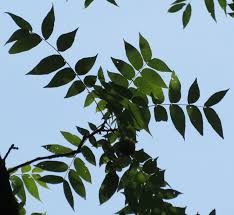
I studied the tree line until it became evident that the bare branches reveal the shape of walnut trees. I first observed just how many walnut trees stood within my sight. I had not really noticed that before. The eastern black walnut is familiar among the hardwoods that cover 90% of the mountains in Western North Carolina. These particular trees were not planted or cultivated. On the downward spiral of Hamburg Mountain, they are pioneer species, a common weed tree, though Native Americans cherished the trees for the wood, the sweet edible nut, and for body oil.
I read about the “thousand canker disease”, carried by the walnut twig beetles which have recently made their way from the west into the Great Smoky Mountains. Without the arborist’s sight, I cannot tell the exact cause of these trees’ death, but I can see in the same line of vision a struggling walnut tree, thin limbs stripped bare at the top, leaves wilting, turning yellow in mid-summer- all signs of the spreading disease.
There is not a moral to this reflection on my challenge to get beyond the annoying sight of dead tree limbs. However, knowing their name, their contribution to this land, and the potential story of their demise gives a personal dimension to these snags anchored by native roots. Studying their habitat I become more familiar with the place I now call home. I stir up a kinship with the natural world that shapes my dwelling place. I know some of their story and see with different eyes their presence in the constantly changing landscape. How about that!
 How About That