In my Western NC Mountain community, the signs of fall include Halloween settings – pots of golden yellow and orange chrysanthemums, bales of hay with a variety of pumpkins displayed; carved jack-o-lanterns, scarecrows, as well as signs of ghostly tales with giant black spiders draped on webs strung between shrubs and trees. My relationship with spiders can generally be summarized in the following personal statements: if I have seen one spider, I have seen them all (even if there are 35,000 identified species); there is not one good spider in the arachnid realm (even though left alone a single spider can remove all annoying insects in a house); it is reasonable to swat all spiders on sight (though this can be a sticky endeavor). Of course it is unreasonable to judge every spider by the fright of a black widow or brown recluse. I have no love for either and almost an irrational fear. Just one news blurb in the year 1973 about the disastrous results of one brown recluse hiding in the bottom of someone’s boot and I never take for granted my boots are uninhabited.
Therefore it is all the more surprising that I decided to allow an American house spider clinging to my kitchen window to take up residence in late spring. She remained beyond reach but close enough for careful observation. I wanted to see how she went about her days. Her web was hardly a web at all, rather a disarray of apparently useful silken threads – handy for hanging out and catching a casual insect visitor by surprise. When I opened the shade in the morning, I would discover such unsuspecting insects, often drawn to the kitchen light at night, rather precisely mummified at the spider’s pleasure. Other than watching for prey, this resident spider rarely cleaned house, though her poor eyesight with a distance vision of no more than three or four inches, may be a reasonable excuse. What you don’t see can’t bother you. I on the other hand could see all – except where the daddy spider came into the picture, I suppose only under cover of midnight. The facts are that spiders are completely solitary creature, living and feeding on their own. When ready for mating the male has to search out the rare sexually mature ready female and reach her before his competitors – competition is fierce. On five occasions from early summer to early fall my female created plump birthing sacs. Watching the translucent ballpoint pen sized spiderlings come to life was one of the more interesting observations. On each occasion activity around the sac took place over several days – and then one morning all would disappear. I did wonder where 100-400 arachnids – depending on survival rate – found their own residences.
Mid-way in the summer a second female spider took up residence at the opposite side of the screen and began a parallel life style – messy housekeeper focused on keeping the larder amply supplied with plenty enough insects to go around, periodically leaving a sac full of eggs. Now a possible 200-800 spiderlings found their way into the light of day on my kitchen screen. Though researchers say that the American house spider lives for about a year after reaching maturity, my astute granddaughter says there are about five eggs sacs in a season. Perhaps that is why five egg sacs later, just as October approached I was deep cleaning my own lair and noticed no sac activity, just two female spiders curled into a somewhat fetal position. Now my screen with its messy webs was ready for cleaning. One swipe and the oldest of the female spiders awakened from her stupor and dashed to the ledge. I thought she was deceased of natural causes and was as startled as she was. As it t turned out, I was caught in the act of evicting her. The second spider, however, showed no signs of life. With a quick calculation I surmised that five egg sacs plus four more from female # two could lead to an insurrection. However my spider tale does not end in speculation.
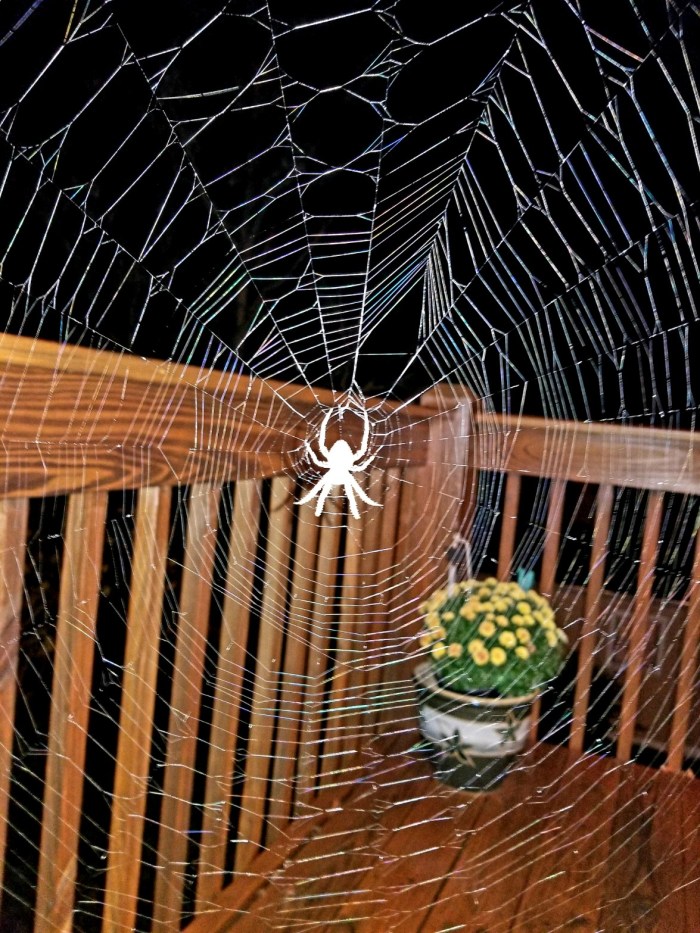
In preparation for fall, I took down webs and put out pumpkins, scare crows and mums. Early this week a new species of arachnid moved in without invitation and no sense of propriety– the back deck orb spider, the kind my daddy called writing spiders. We sighted the sudden appearance of an enormous web from roof line to railing just after sunset, a large visitor with long brown and green striped legs and a cross on its back, sitting bright and center ready for a night watch. Fascinated with its size, appearance, and web, we decided to leave the stunning spider in place for a good night’s catch. The following morning the creature seemed harmless enough to leave for 24 hours of observation and fact finding. How else can I overcome stereotyping a natural world rich with diversity or generalizing a threat from one spider to every spider? Early the next morning when I opened the back deck door to let our dog Kate out for a run, her fluffy coat and tail were suddenly dragging silken threads and I was eye to eye with the big mama spider scrambling for safety. I needed to plan a removal tactic, quick. With a stick in hand I pulled the web down from the gutter and the spider disappeared in a flash. Twenty-four hours later I pushed the door open and the spider appeared in my face within a breath’s reach, strung between door and siding, way too close for comfort. Using my heightened survivalist instinct, I swatted with a newspaper, and the spider and web instantly disappeared- until I felt its legs stretching out on my neck, right near the jugular. I have never practiced karate, but my actions were swift, hand chop from my neck to ground and one good stomp. Sorry, but it is true, I felt my life threaten, having read that the bite of an orb spider when it senses danger can be mean. Well so can mine. Halloween at my house will go sans any sign of webs or spiders. I leave you with my one and only spider study and will henceforth leave all further spider observations to the eyes of the arachnologists.
https://en.wikipedia.org/wiki/Parasteatoda_tepidariorum
How Spiders Work https://animals.howstuffworks.com/arachnids/spider8.htm

 How About That