Dawn Chorus

I awoke at dawn this morning to the amazing spring chorus of bird song. How can such a cacophony of notes create such beauty and harmony? Surely this is what the psalmist calls a morning of heavenly praise. “Give praise to the beloved O heavenly hosts, sing of Love’s glory and strength (psalm 29).”

The scientists refer to this occurrence as the dawn chorus. When the light is too dim for the birds to yet begin to forage, the feathered creatures find time for full-throated social interaction. “Listen,” sings the male, “I am strong and vital.” I am certain the 21st century female replies, “So am I. So am I.” For the most part I am cannot identify the birds’ signature songs, yet even the long drawn out lament of the mourning dove sounds hopeful.

Grateful for a blessing at the start of my day, I listened from my bed perch for most of an hour imagining the tree tops all through my neighborhood filled with song. I pictured a wave of dawning light moving around the earth accompanied by a chorus. Just as the volume began to diminish, a single crow swooped in with his raucous attempt to stake his own claim on the day. Close behind came the rushing sounds of tires as the world stirred into action.

On the first Sunday in May the United Kingdom celebrated International Dawn Chorus Day, and encouraged people to rise in the early hours of the morning, to step outside and to listen to this awesome performance. We missed the date, but if you seek out “dawn chorus” online, you will find many recordings of this phenomena – not quite the same as rising early in the morning, but inspiring none the less.

dawn chorus

Fooling with Words: Celebrate Poetry

The days of the month slip from April to May. I want to do my share to celebrate poetry and applaud poets who gift me with words. While I am a literature lover, it was late in life when I fell in love with poetry. Though I have always enjoyed the familiar Dickinson or Frost, and laughed with my children through Shel Silverstein’s play land of words, for too, too long I approach the work of poets as ingenious expressions that I needed to analyze, dissect, or diagram in order to take away the meaning. And if I didn’t “get it”, well that was my fault, not the poet’s.

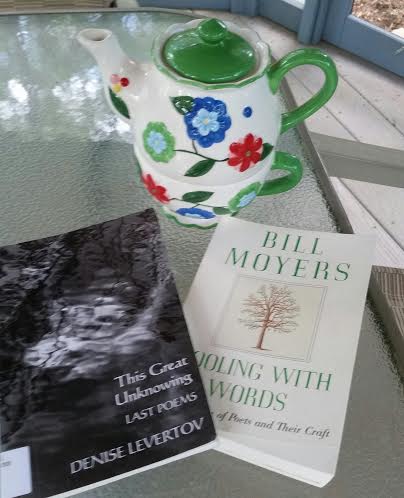
Bill Moyers’ Fooling with Words introduced me to another world of poets, and I began to feel the way words slip across my tongue, creating life-giving harmonies; producing words, lines, phrases that resonated within my soul – like “Yikes!” “Yippee!” “Oh yes!” “Oh my!” I discovered words expressing beliefs, values, experiences that direct my path; painting pictures I can step into; making more evident the mysteries of life; celebrating the universe; praising the divine.

Any list I make would be incomplete, but over the years I have been smitten with Coleman Barks, Jane Hirshfield, Marge Piercy, Maya Angelou, Wendell Berry, Pablo Neruda, Langston Hughes, Bill Collins, Mary Oliver, Denise Levertov . . . I have poetry of the lesser known but equally gifted writers, some of whom I have met in my writing groups.

Earlier this month, I scanned the library poetry display for a new read and picked up Denise Levertov’s The Great Unknowing. The title and cover told me there was something to be discovered in its pages. These forty poems were finished but unpublished at the time of her death. At the age of 74, Denise Levertov left behind a half century of twenty volumes of poetry.

I gasp with delight as I read  “Aware”.

“When I opened the door

I found the vine leaves

speaking among themselves in abundant

whispers

My presence made

them hush their green breath,

embarrassed; . . .”

In “a Clearing” she takes us to the end of an enticing country road arriving at a

“paradise of cedars . . .

an expanse of sky where trees and sky

together protect the clearing.

One is sheltered here

from the assaulted world . . .

It is a paradise and paradise

is a kind of poem, it has

a poem’s characteristics:

inspiration, starting with the given;

unexpected harmonies; revelation.

It’s rare among

the worlds one finds

at the end of enticing driveways.”

Keeping company with the poets is like sitting with kinfolk or the best of friends, sharing ordinary wisdom or fooling with words. Delightful afternoon with a cup of tea.

fooling with words

World Within Worlds

Words are another wow factor in my life. Since childhood I have opened the pages of my dictionary with the wonder of discovery – the origin, variants of meaning, pronunciation, uses in a sentence, synonyms, and antonyms. I was clearing off a bookshelf last week, and discovered the Merriam Webster I had used since college days – its worn blue cover, the binding pulling away from the spine at the corners. Inside the cover I had at one time begun to make a list of the words I had looked up – harridan (scolding old woman), insouciant (lighthearted unconcern)….I don’t often use its pages these days because my fingers more immediately type the word in Google search and open up whole new worlds of information.

This past week I stumbled into an expanding universe of new words, and developed an enormous admiration for those that have explored the heavens as astronomers, despite odds I could not have fathomed. In the novel, The Stargazer’s Sister, Carrie Brown recreates from the nineteenth century the story of Carolina Herschel, sister of composer and astronomer William Hershel. At a very early age “Lina” falls under the influence of her brilliant brother, twelve years her senior, as he opens her mind and imagination to a world beyond what we see.

Animalcules – that’s the word that first grabbed my imagination. William delights in giving Lina vivid images of the discovery of animalcules. I immediately liked the way this unfamiliar word slipped across my tongue, and formed images of microscopic animals. I needed to know more. Animalcules – Dutchman Anton va Leeuwenhoeck’s name for the little swimmers he discovered in his microscope. After her introduction to the microscopic world, Lina begins to draw animalcules with tails and horns.. When William points out that these animalcules are “worlds within worlds”, Lina began to see in each raindrop that ran down the glass window a whole city with “its minarets and towers, its bustling populace” (17).

Herschel, captivated by the stars, had already begun his own quest to build a telescope of mighty proportions, in order to see the hidden world in the night skies. I am not sure why I was caught off guard to discover that the prevailing attitude of the times created barriers in his efforts, for he was tampering with God’s territory. We do seem to fear whatever challenges the world as we know it. I know I don’t want to ever lose the wonder of our universe, and miss seeing the “worlds within worlds.” It’s rather tied to a realization that I am not ever alone or totally on my own. There it is again -that immense web of relationships that forms every aspect of our universe.

Today’s language for what can be seen under the microscope or at the end of telescopes creates a vocabulary well beyond my claim for knowledge. Animacules – now that’s something I can get my head around. Little swimmers invisible to the naked eye, but essential to my world, mysteries to unfold. Cause for gratitude for the unseen life that makes my own existence possible.


Brief Lesson on the Invisible

Over the past two years I have been working on a spiritual memoir exploring the beliefs essential to my faith identify as they have been shaped by the circumstances of my life, in particular love, suffering, death, and resurrection. The foundation of my belief occurs in experiencing a relationship with the divine, whom I call God. Though I know God as the single unchanging presence in my life, my relationship and my understanding have definitely evolved. How could I possibly contain the infinite in a single metaphor or encounter?

Several years ago, searching for the God within and around me, I could best “see God” in the goodness of others. Otherwise the invisible divine was “out there”.  But in truth I wanted to feel myself submersed in the God of love. I wanted to experience an unbreakable connection. Watching the sunlight pour through the window over my shoulder, I noticed for the thousandth time the specks of particles dancing in the sunbeam, matter that would become invisible when the sunlight moved

In that moment I grasped as never before that all that seems like empty space – within and around me – is filled with the presence of the divine. It is so difficult to feel alone when I am surrounded by the teeming waves of God’s infinite love. It is difficult to feel powerless when I am wrapped in the energy of God’s love pulling me forward.

Recently I began to read Carlo Rovelli’s Seven Brief Lessons on Physics described on the flyleaf as “All the Beauty of Modern Physics in Fewer than a Hundred Pages”, a “book about joy of discovery”, and “surprisingly easy to grasp”. How I could I pass up this “best selling” opportunity to expand my horizons into the broader universe – in less than 100 pages.

The first chapter – I read at least three time – describes one of the great insights of Einstein which parallels the transformation in my understanding of God. When imagining the force of gravity that draws all material bodies towards one another, Newton described bodies moving through space, a great, empty container. “What the ‘space was made of, this container of the world he invented,” Newton could not say (5).” Later Einstein in a “stroke of pure genius” realized that Newton’s “space” through which things move, and the “gravitational field” are the same. Space is no longer distinct from matter, it is an “entity that undulates, flexes, curves, twists.” How about that! Space in not emptiness, nor is it a fixed container. Neither is God. And the universe, as I read it, says Amen, so it is. How about that!

Shaping My Worldview

I see my world through a lens shaped by my experiences in life. I am Mother and Grandmother who takes seriously the pure joy of these loves. Widowed after nineteen years of marriage, my pursuit of education, the teaching profession and theological studies took on new meanings. I consider my religious identity, which took root in my growing up years as a Catholic in the South, formed more intentionally in six years as a young adult living in a religious community, and emerging into ever new ways of understanding God, an essential part of who I am.

Born near the Atlantic Ocean and vacationing in the North Carolina mountains near my Daddy’s childhood home, I developed a love for the natural world. These experiences bind me to a loving creator. In addition to the world of words and books, I find great joy in mountain hiking, traditional and bluegrass music, playing notes on our dulcimer, or crocheting patterns marked for beginners. Child of the South. Nun. Wife. Widow. Mother. Grandmother. Teacher. Writer. Friend. There’s more, so much more that captures my heart, but this makes for a good beginning. How about that!

Invitation to “Come What May”

From the beginning – I have scribbled in notebooks since I was eight years old, wanting to make sense of the world through words. I thought that perhaps arriving at the just-right alignment of words in my universe should put everything in perfect order. In January, I celebrated my 70th birthday and to date I am still playing with words. Along the way I learned to love the process rather than the outcome and to embrace the questions more than the answers. Awe and discovery keep me alert and what I don’t know or didn’t realize continues to absolutely amaze me.

When my grandchildren uncovered this truth, they became my echoes. Listening to their adventures, their creative spins on life, and astute observations, I am apt to say “How about that!”. They turn to me with big grins, a shake of their heads and repeat “How about that!”. “It must be an old-people’s thing”, they say. Yes, I am elder-ing and love this curve in my life. All my life I have been nourished by writers, and now that I am moving at a more measured pace, I want to join their ranks, taking my turn at spinning the wheels of wisdom.

Welcoming the privileges of being an old lady, I am also much more willing to “let come what may”. Instead of making my to-do lists, I rely on a notepad shaped like the bottom of my morning coffee cup. I randomly scribble those things I should consider doing inside the circle – something like a daily mandala. Then I pay attention to what floats to the surface, and gives me a nudge. I like to think of this method as an organic approach to my day. My posts will be just that – an organic emerging of “come what may”.  I welcome you to join me in the wanderings and wonderings. How About That!