Winter’s Light

Crisp winter light
casts pen and ink shadow
drawings on every surface;
black iron fences sparkle
with metallic gleam; bejeweled
glass glistens; tree trunks
take on a polished look;
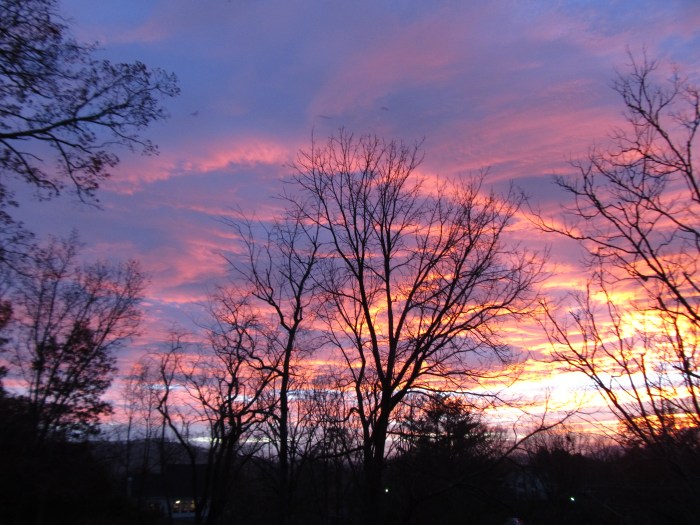
rose streaked sun rise,
burning sunsets mark
our wintering days.

Winter’s sunlight gives clarity.
a distant horizon seems closer,
tasks at hand seem less demanding
as the sun’s warmth suffuses
our wants and waiting, for this is
a hunkering down time.

I am drawn to the sun, fascinated by the slight changes in patterns it produces day to day. From the southwest exposure of my deck, I keep track of subtle differences; tracing the curvature of the rising, shadow making, setting sun. Every day I look forward to an afternoon tea and biscuit break, allowing the sun to reset my disposition. My tea time alters as the earth’s relationship to the sun shifts.

In this winter light as the sun warms my bones. I begin to feel the nudges of aging. The patterns of my life are changing. As I embrace my role as a contemplative elder, I recognize the new turns my life is taking, the new limits, a slower step, a quieter response to life. When people ask about retirement – and that question always comes with assumptions and expectations of a kind of wanderlust of leisure – I more readily tell them what I am “doing”, rather than acknowledge my preferred way of being – sitting in silence observing the natural world, returning thanks for creation, reading and reflecting on the Divine’s unending pathways for revelation. Too much value seems inevitably tied to the external life, what I am doing? The sun conspires with my desire to sit and absorb the goodness of creation.

Ronald Rolheiser in Sacred Fire  notes shedding is a necessary step in this journey, that biology conspires in old age to help mellow our souls; that signs of aging are an initiation into another way of life; that physical diminishment matures the soul; that by design this stage is more about reflection than productivity. I am very aware that inevitably these “actions” of “being” generate goodness. In silence I find myself prompted to give from the gratitude and love I experience.

I feel I am a privileged part of an awesome universe. I too want to live as an illuminating spark – now and in eternity.

“What has come into being in Him is Life, and Life is the Light of the World.” John 5:3-5.

May you too find warmth and discover good news of great joy in this wintering season.
sunset.JPG

Gift of One

The energy of one
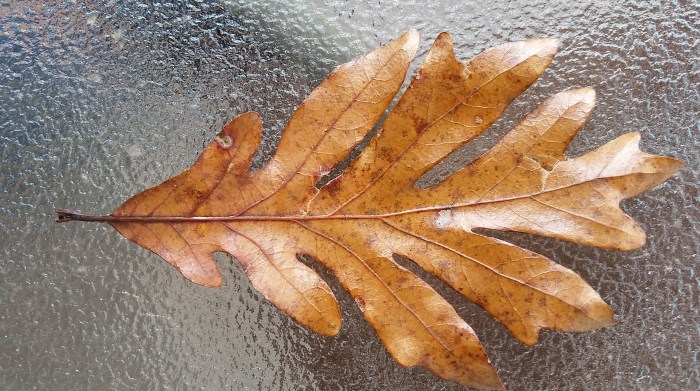
brown oak leaf gliding
past the window pulls my
attention away from random
thoughts colliding within.

Sun’s sudden appearance
after a long grace-full rain,
a momentary, subtle shift
from gray to golden,
awakens a desire
to share good news.

One Seed,
One Flame,
One Word,
One Laugh,
One Chime,
One Breath,
One Hand,
One Gift
Is enough
To change
One’s Life.

oak-leaf

Song of the Evergreen

Fall has changed my landscape, taking my breath away. My words seem to disappear. I have been looking at the world through the end of a kaleidoscope, every slight turn, every new angle, producing a new vision. The trees, stripped bare, open my horizon. I stay inside on the days the thick veils of smoke from burning forest fill the air. Nature prophetically parallels the changing landscape taking place in society. In silence I let go of the chaos of thought, creating space for a new configuration.

As a child I was churched in liturgical seasons which I experience as divine revelation made visible in nature’s signs and symbols. This unfolding begins with advent, waiting for what is to come. Light diminishes, darkness moves in, but we wait with expectant hope for Love.

I was running late for church the first Sunday of Advent and reached the door just as the chanting began. “Wait for the Lord; be strong; take heart.” I was transfixed by this familiar and reassuring refrain. A large green wreathe stood in the center of the sanctuary; evergreen, the symbol of hope. Four candles, one light for each week of waiting. As a new flame is added, hope burns brighter.

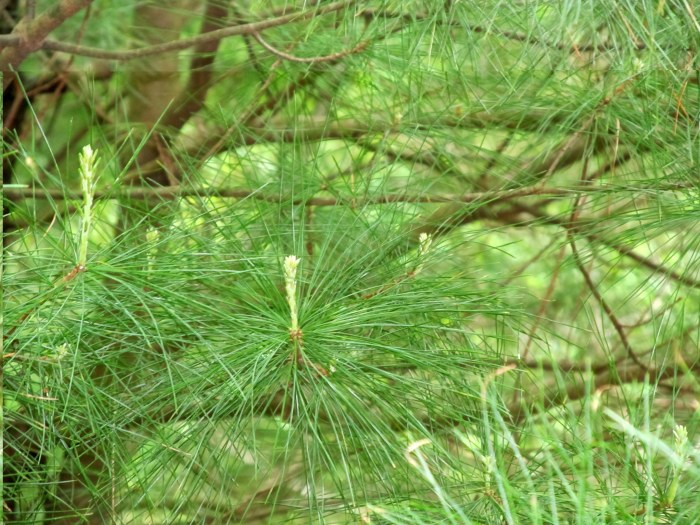
On a Sunday afternoon hike  I found myself walking to the rhythm of that mantra. Be strong. Take heart. Hiking is a truly Zen experience for me. I can let go of every thought and awareness, moving forward one step at a time. When I pause to catch my breath, I look around me, reading the signs of nature, discovering its messages. More than once I have had the feeling of standing of holy ground, stepping into the universe’s cathedral. On this particular walk, I right away saw the thick trunks of trees wrapped in braided vines, tall hardwoods, pillars creating a firm foundation. Ferns spread on the ground like green altar cloths. The evergreens stood out, a new stand of pines relishing in the possibility that through the winter, the light would make its way into the usually dark forest and they would grow!

Each of us has our own way of making sense, finding meaning, expressing understanding. The signs and symbols speak to me; from the sights, sounds, and touch I draw courage, not a lasting supply, but enough to get me from one week to the next. I am going to envelope myself with this season, using the time to reflect on past, present, and future. I know a seed is being nourished in the darkness and trust that in time I will emerge with the light, finding new answers to old questions. What does Love compel me to do?

song-of-the-evergreen

Acorn Action

Today nature has dropped a gray curtain between acts. Tomorrow’s wind and reasonably cool day will replace the unseasonably warmth we have been enjoying. The scenery will swiftly shift from yellow, reds, and oranges, to a minimalist’s portrait of beautiful, but bare essentials.

Meanwhile I cannot miss the busy stirring of the creature world, thanks to an abundant crop of acorns. The roof top pounding and constant pings of gutter hits have been replaced with the incessant “kuk”s and “quaa”s of squirrels and a bumpy ground bed. It is impossible to walk across lawn, sidewalk, or street without hearing the crunch and feeling the soles of my feet being massaged.

Surely the mother tree is quite literally rooting for her little acorns to find their way under the soil, ensuring a legacy – for everyone’s good. Meanwhile the creature world is stirring with frenetic energy – well the squirrel is frenetic, the blue jays persistent, the ground hog mulling it over, and the black bear, sighted on the corner in the early hours of the morning, inhaling acorns by the pound.

Adam Warwick, stewardship manager and wildlife biologist at the Nature conservancy of North Carolina says that during the fall season the black bears consume anywhere between 15,000 and 20,00 calories a day to prepare for winter – and acorns supply the Western North Carolina black bear much of this diet. To convey the big picture, Warwick provides a calorie conversion chart – and a 25 pound bag of dog food is 42, 425 calories – or 11,165 acorns! No wonder those bears are food scavengers! A loaf of bread is a quick calorie, low labor choice. (https://mountainx.com/living/the-bears-are-back-in-town/).

Just around the corner the deer, chipmunks, rabbits, and raccoons are busy competing for the spread of acorns.  And did you know that like good wine, acorns come in preferred tastings of red and white varieties? How about that! ( http://blog.nwf.org/2013/10/the-wildlife-benefits-of-acorns-and-oaks/ )

Nature is resetting the thermostat and determining the precipitation that will shape my winter days. I’m going to guess that the way the wind blows in the coming months is a little less predictable. However, if I were wise, I would take my cue from the creatures with their determined, resourceful, and think-ahead actions. I have had the heating system checked; the car battery is doing fine; wool socks, long sleeved shirts, and sweaters are accessible, and the soup and chili recipes marked. Time will shift to a different pace; the pattern of my day will change. Nature signals me it is a good time to take stock of my year. Hibernation certainly has its good points.

acorns

Nature’s Creative Turmoil

Some days the complexities of the universe overwhelm me – like the power behind nature that overflows banks, uproots trees, and burns through forests. Too much. Too fast. Left to its own pace, nature heals and restores itself, creating new life, making adaptations, and pushing forward. Last year I felt dwarfed by the massive beauty of the meadows, peaks, domes, rivers, lakes, and waterfalls in Yosemite. I could not begin to grasp the reality of the furious, chaotic and seemingly catastrophic geologic forces that began millions of years ago and led to this majesty.

Rangers in the National Parks readily point out that forests and grasslands have evolved to deal with their own natural disasters, in a historic cycle of growth, dieback, and growth. Eco systems eventually recover and sometimes create something new in the process.

Some years ago in a deep state of grief I became fascinated with nature’s capacity to heal itself, studying the impact of the 1980 volcanic eruption of Mount St. Helens on the surrounding destruction of life and devastated landscapes. I was encouraged by the return of the first signs of plant life, such as birds flying overhead dropping seed into small crevices that held enough moisture to support particular forms of plant life.

I began to look to nature for the continued signs of hope and promise and I return to nature to be reminded of these lessons over and over again. When historic floods and turbulent winds destroy towns that are a part of my own familiar landscape, I wonder how as a community of beings, we can begin our own cycles of adaptation and re-growth. Nature takes its time; change begins with but a seed. Human communities feel the urgency to make rapid restoration.

Nature says – we are not starting over; we build on what we have at hand – it’s a dynamic, evolving process. Creation also gives clear evidence that this is an interdependent process. We are integrally dependent on one another to identify the resources and the path to recovery. And despite our good, immediate efforts, it takes time to create new life. The reassurance that all things can be made anew with those who trust and work with one another for the good of the entire community provides hope, promise, and possibility.


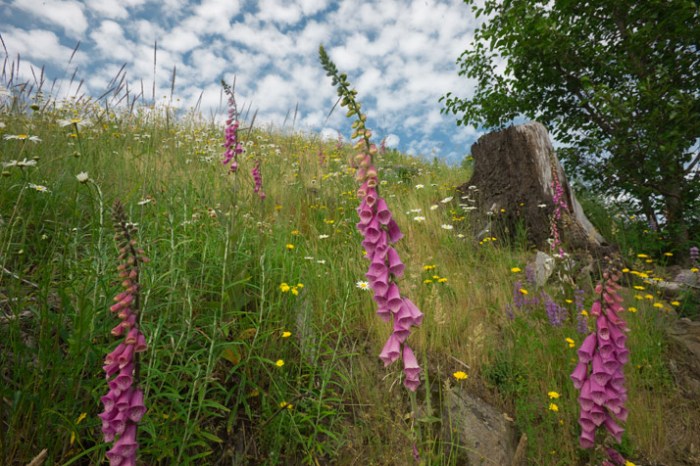
Photo: Thirty years after the blast, Mount St. Helens is reborn again.

Early colonists bloom on a hill near the volcanic monument’s Coldwater Lake: foxglove, lupine, pearly everlasting, red alder. The tree stump is a reminder of pre-1980 logging operations.

Photograph by Diane Cook and Len Jenshel

National Geographic.com/2010/05/mount-st-helens

mt-st-helena

Curtain Rising

Sitting in the black porch rocker, taking an afternoon break from thinking, planning, doing, I watch yellow birch leaves continue their spiraling dance. A light wind from the East stirs the trees, portending rain and cooler days. Anticipation bubbles within me, like the moments just before the curtain opens on a grand performance, only this is more like a strip tease. Acorns are hitting the ground with popping applause.  After a number of encores, the trees will be bare, revealing a new landscape. I am a newcomer to this stage, first time in this front row seat. The final curtain call will reveal a new horizon.

This well staged drama is a reminder that all life tells the story of change. Carrie Newcomer sings:

Leaves don’t drop they just let go,
And make a place for seeds to grow
Every season brings a change,
A seed is what a tree contains,
To die and live is life’s refrain

Weeks ago when the colors of summer began to fade I was holding onto the scene with a tight grip. “Not yet. Not yet. I am not ready.” All the while I knew change was inevitable. Now I rise to a blessed coolness that takes the edge off the lingering heat, well past the fall equinox. The bite of a honey crisp apple, straight from the tree to me, awakens a taste for Fall. Though I am not fully ready to let go of the peach-sweetness of summer, I begin to imagine the biting tastes of red pepper and cumin in a spicy bowl of chili. The baskets of mums are beckoning and I am once again forced to decide – yellow, gold, purple, or burnt-orange?

I have lived 70 years in a temperate zone and never grown tired of the dramatic production of changing seasons. Nature nurtures an attitude that reminds me to embrace transition – something ever new and eternally the same will be woven together. The curtain will open on a vision that catches the moment between now and then. What has remained hidden from sight can be seen for a time. I am looking forward to the exploring another view. It won’t be the quite same the next time around, and neither will I.

leaves-1036560_960_720


The Sky is Falling

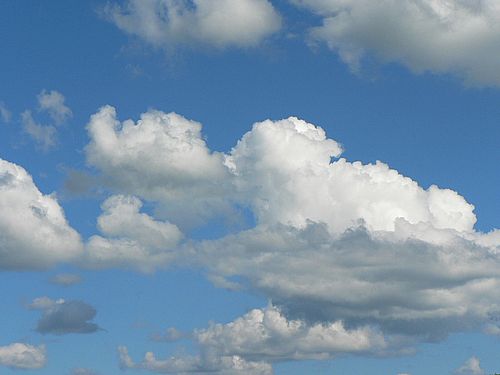
I am discovering that the wisdom of aging comes with a slowing down, prompting me to sink into the moment at hand. That’s how I began to befriend the sky, conceiving of its presence as an immense blue canvas on which forces of nature paint an accounting of the day just as it is happening. The artist’s pallet holds the elements of light, wind, water, and temperature and produces not simply a representation of life as it is occurring, but the very reality that gives shape to my day, sometimes my very mood. From dawn to evening, night fall to daylight rising, the sky is my protective shell. I count on it being there – and it is – even if I don’t give this a single moment’s thought.

Gazing up at the curved canvas I am reminded of the constancy of change in life, the subtle ways my day, my world is being reshaped. Approaching fall in the mountains, it is difficult not to notice the dense fog that hangs over the early morning. I begin to anticipate, like clockwork, the warmth that will lift the cloud, unveiling the stretched blue fabric of my day. Today the clouds spread like a bed sheet, hanging low and teasing me with its dense gray appearance. Stratus could up to pranks. Will it rain on the roofers and then their work day will stop?

I favor the fairy streaks of high cirrus clouds that produce a light airy step in the day, but it only takes a turn of the head and sky is filled with white puffy cotton candy, the cumulus clouds that appear like mounds of whipped cream. I can quickly fall into my childhood memories, lying on the sand at the beach, naming the clouds by the images they depict.

One of my favorite Charlie Brown cartoons depicts Charlie Brown, Linus, and Lucy lying on the top of a hill. Lucy says “If you use your imagination you can see lots of things in the cloud formations. What do you see, Linus?” “Well those clouds up there look to me like the map of British Honduras…that cloud up there looks a little like the profile of Thomas Eakins, the famous painter and sculptor…over there …the impression of the stoning of Stephen…the apostle Paul standing there to one side.” Lucy replies, “That’s very good…what do you see in the clouds, Charlie Brown?” “Well, I was going to say I saw a ducky and a horsie, but I changed my mind?”

It is all a matter or perspective, isn’t it? Now I see great tears in the blanket that has hung overhead all morning; the brilliant blue canvas reappearing. My life is not separate from nature’s painting of the day; I am encouraged by the change that constantly takes place; I am delighted with the beauty, grateful for the warnings; overwhelmed with the thought that this protective embrace has been present for all generations of peoples. My ancestors stood under this sky. Now that’s a story I could tell.

clouds-in-blue-sky

Labor Day River Musings

On Labor Day I found myself totally taken in by an afternoon river hike, despite the fact that a Google quest led us on a misguided wild goose chase around Lonesome Mountain – the name says it all – twenty plus extra minutes of hair pin turns. Even as we made the ill-judged left turn, I was eyeing a sign that read “Boat Landing” – with an arrow to the right. “Isn’t the river that way,” I asked aloud. Imagine the startled realization that if I pulled out of our driveway, turned left and maintained a straight, well periodically curvy, path, no turns, I would arrive at my goal in 25 minutes.  I admonish myself never to start out on an excursion without verifying directions with an honest-to-goodness paper-in-hand map. Where was that AAA triptik when I needed it? However, as soon as we arrived at the trailhead – another 10 minutes U turn experience – everything about the journey melted away. The destination was indeed inescapable beauty!

River Watcher

Great Blue Heron, long-legged wader,
S-curved neck, straightening into
Yoga pose, poised, paused,
caught in the act of perfecting
the Now, watching the waters stir,
waiting for sight of passing prey,
laboring in reflective stillness
Give me O Lord the patience
of an heron attending only
to the task at hand.

Sensing Beauty

Roots and rocks press deep
into passing feet. Late summer
breeze brushes my body’s
beaded sweat. Scent of campfires,
smoke rising, sodden earth at river’s
edge. Sound of laughing waters
calling children to play merges with
onlookers’ murmurs of delight.
Splashes of yellow goldenrod, red
jewelweed, and purple Joe-pyes paint
Laurel River’s landscape. No labor
today, only inescapable beauty.

GreatBlueHeron.jpg


An August Appreciative Gaze

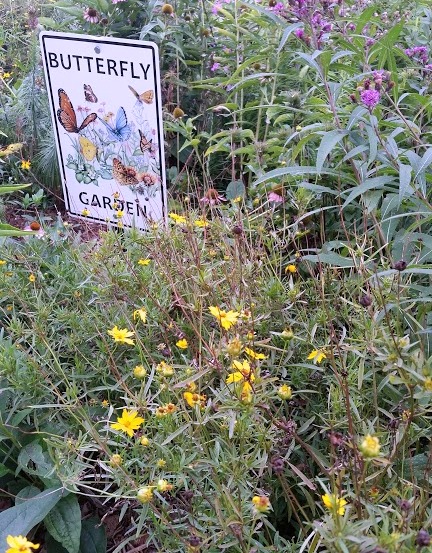
Appreciate gaze. That’s the phrase that settled in my mind’s eye this week. Late August and the cultivated butterfly bushes, cone flowers, daisies, and their wildflower companions are browning, returning to seed. I welcome the cool breezes that have broken through the dense heat waves of August this week, but I am not ready for the season’s change. I want to cling to the lift that summer’s colors cast on my day, the ritual of stopping to admire my neighbors’ gardens on our evening walks, standing with amazement at the nature’s display.

Somewhere along my writing way I copied a prayer in my journey notes without acknowledging the author. “Bless God bless; the whole world bless; quietly through the night; gently through the day; each and every creature you meet along the way. Bless God bless.” Just saying the words expands my delight.

Ronald Rohlheiser in Sacred Fire writes that we cannot give ourselves the blessings we need, but we can bless others and our heart will experience the exuberance that makes us say “God, it feels good to be alive.” This is what I learn from the summer’s profusion of color – to bless is to take delight in; to cast an appreciative gaze.

Mid-June when the stress of a move began to dissipate, I entered into the summer’s landscape with the intention of attending to the details I often miss because I am blinded by busyness. I discover a wealth of blessings when I delight in profusion of purples or stars forming constellation in the center of a flowering stalk. Nature instructs me and though I’m not a wildflower or garden perennial, I know what it feels like to be blessed with an appreciative glance. When another sees me, acknowledges my presence, I grow into a fuller sense of my place in the world – just as I am. How can I make a return for this goodness – I too can bless those who come my way with an appreciative gaze.

August Garden 4

Tale of Two Snags

I listen to the rapid chattering of cicadas in August, riding waves across the still morning sky. My thoughts rattle about for attention. There is much in this world to worry the mind, but I choose to begin with what is right in front of me. For several months I have eyed two dead trees that stand at the far edge of my neighbor’s yard. It is impossible to miss these dry bones and their tangle twigs. They obstruct my view of the horizon, which would otherwise be framed in towering green spires. Reaching out from a vine covered trunk, the branches bear no semblance of symmetry. Believing that I can learn from the patterns and habits of all created things, I begin to wonder what stories these trees hold in their stripped limbs.

Snags. Standing dead trees are referred to as snags. Though I don’t know the true origin of the word, I imagine that the tree limbs in flooded waters can snag boats and create unwanted problems. I have run into a snag or two in my own life. The birds that sometimes hang out in the trees must feel like they have snagged a good place to land. I myself have hoped to snag some good fortune here or there.

This morning I began to ferret out the story these snags might tell. While I may fret about the distorted view of an otherwise sharp horizon, the trees belonged here well before I arrived. Brian Swimme reminds me that over billions of years Earth’s life developed without eyesight. “We contemporary humans identify so strongly with our visual elements of consciousness that we have some difficulty conceiving of a time when life proceeded without any eyes at all…(in Thomas Berry’s The Dream of the Earth).” We have the privilege to see and reflect on the wonders of this world and care about what happens to our natural world. If I consciously turned my eyes towards their twisted limbs what would I learn about the dwelling place I now call home?

I studied the tree line until it became evident that the bare branches reveal the shape of walnut trees. I first observed just how many walnut trees stood within my sight. I had not really noticed that before. The eastern black walnut is familiar among the hardwoods that cover 90% of the mountains in Western North Carolina. These particular trees were not planted or cultivated. On the downward spiral of Hamburg Mountain, they are pioneer species, a common weed tree, though Native Americans cherished the trees for the wood, the sweet edible nut, and for body oil.

I read about the “thousand canker disease”, carried by the walnut twig beetles which have recently made their way from the west into the Great Smoky Mountains. Without the arborist’s sight, I cannot tell the exact cause of these trees’ death, but I can see in the same line of vision a struggling walnut tree, thin limbs stripped bare at the top, leaves wilting, turning yellow in mid-summer- all signs of the spreading disease.

There is not a moral to this reflection on my challenge to get beyond the annoying sight of dead tree limbs. However, knowing their name, their contribution to this land, and the potential story of their demise gives a personal dimension to these snags anchored by native roots. Studying their habitat I become more familiar with the place I now call home. I stir up a kinship with the natural world that shapes my dwelling place. I know some of their story and see with different eyes their presence in the constantly changing landscape. How about that!

walnut