Butterfly Feast

Just after my noontime lunch, I sit on the porch with a glass of peach tea, hoping for a sacred pause in a day that moves quickly from beginning to end. Hanging pots of pink and purple flowers, freshly watered, attract butterflies looking for what they want most out of life – a taste of heaven.

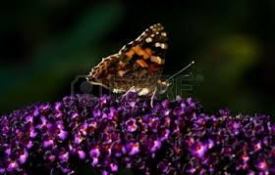
Butterfly sips sweet
nectar, delicate wings fold,
poised to return thanks.

No bells call you to
worship. Only the delight
nature freely gives.

One fleeting moment,
my heart stills, beholding this
eucharistic feast.

The Old Farmer’s Almanac tells us that butterflies and flowers were made for each other and that, as other poets pointed out, “butterflies are flying flowers, and flowers are tethered butterflies.” Such is the communion of nature.

butterly wih folded wings


The Wonder of Weeds

Somewhat like pointing out what is beautiful, labeling a plant a weed often depends on the eye – and circumstances – of the beholder. Growing up on the east coast, close to a beach, hands down, sandspurs were the enemy of every barefooted child. Sandspurs dominated our sandy lawn. My parents gave my brothers and me the summer chore of pulling up these stubborn plants and my animosity deepened. In my young adult days of back-to-earth living on a Kentucky farm, thistle and poke weed prevailed as pests. For the past twenty-three years the landscaped border of our small front yard was glorious with its fig tree, camellias, rhododendrons, azaleas, long-needle pines, maples, all planted by previous homeowners. However, the large back yard was turned over to natural habitat, re-designed over the years by storms. I loved the wild violets, profusion of clover, and dandelions. But oh, I dreaded the springtime appearance of chickweed.

My mountain dwelling has a yard with lovely kousa dogwoods, Japanese maple, cedars, viburnum, pear trees – and a few sparse patches of daisies and lilies. We also acquired a well-mulched hillside just waiting for another year’s planting. Despite our good efforts and intention to save the space, weeds appear as fierce competitors. When the sun gives me a brief reprieve from this summer’s heat, I find myself armed as though for battle, ready to commence the pulling up of weeds. Dried wayward spring onions and the persistent nutsedge yield to just a gentle pull; dandelion greens, and the oxalis which reminds me of a patch of shamrocks, also give up with little fuss. However, I am forced to dig and chop at the roots of thistles, unless I catch the plant as it first appears. But patches of crabgrass hold tight to the ground despite forcible effort. I put aside trowel and take on the roots with my long-handled shovel. Meanwhile I grow pleased at the number of weed-filled clear plastic bags I have collected.

However, I admit to having to do some attitude work as well. I had to arrive at a conscientious conclusion for what I experienced as personal conflict. To designate certain growing things as undesirable seems contrary to my general attitude that nature reveals wonder and all created things are purposeful, deserving my respect. The Garden Counselor (http://www.garden-counselor-lawn-care.com/) says that some people love crabgrass – farmers growing summer forage for cattle; environmental agencies cleaning up oil spills; homeowners who wouldn’t otherwise have anything green in their lawns. It is the very nature of crabgrass to form a group of like-minded weeds and to compete with other plants for room to grow. Every single crabgrass plant can produce 150,000 seeds.

Agriculturalists at Penn State Extension (http://extension.psu.edu/) declare that weeds can be beneficial as soil stabilizers, habitat and feed for wild life, nectar for bees, and weeds lead to employment opportunities. How about that! However, according to the extension agents weeds are generally classified as out-of-place, competitive, persistent, pernicious, and interfering. A weed doesn’t mean to be a weed; it’s just doing what comes naturally.” In the end, it’s all about balance.” Apparently when the undesirable qualities outweigh the apparent good points, weeds bring out the human inner need to control. The worrisome weeds brought out the warrior in me.

However, I have been making note of the tightly planted pollinator and wildlife habitat gardens in our community. Next year I will have that hillside filled with five varieties of daylilies; pink, yellow, and deep red coneflowers; southern blazing stars; milkweed, patches of phlox and the weeds won’t have room to work their way into my world. Right?

20160726_112541-1


Blooming Surprise

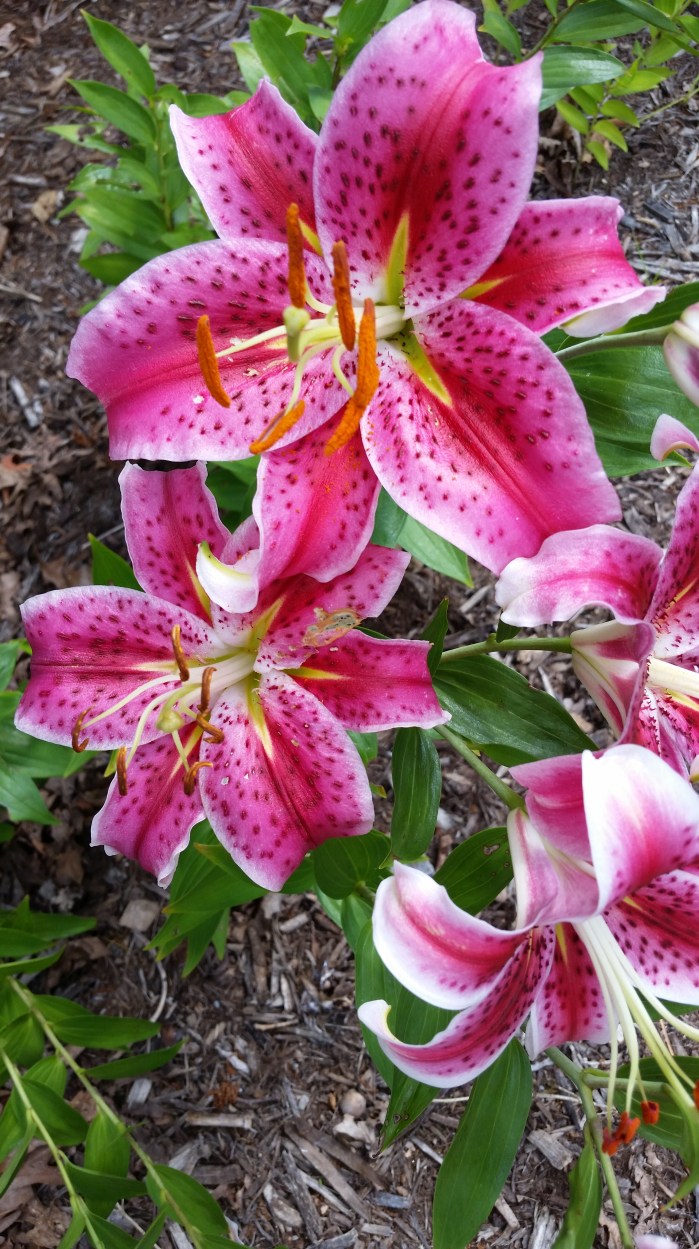
Surely it was early autumn
when the shooting star
burned its way to earth

planting its dust
in the  humble pine mulch
near our back wall.

Between winter and summer
solstice, particles cooled,
a bulb shaped, roots formed.

I never noticed
the signs of wonder
silently taking place

until a pink six petal
brilliant star appeared
in my garden, mid-July.

Under summer’s burning skies
the stargazer lily gives
a glowing performance.

It seems at first that it took but a few seasons to produce such a delight, but when I consider this as a moment in the dynamic, ever continuing history of the universe, I realize that it takes billions of year to bring forth such complex beauty. It is awesome that we have been given a part in this grand story.

20160718_111520

Tree Top Preacher or Sermon in Song

It was a rather foolish thought, I know, but just the kind of irrational anxiety that emerged when I was faced with leaving my secure nest, home for 23 years. What if there were no birds on the other side of the state to sing to me when I awakened? For years, the morning ritual of bird psalmody erased my night fears, and blessed the start of the day.

Numb and exhausted the first few days after my move, I was only vaguely aware of the trills outside my bedroom window. However by the fourth day, sitting on the deck with my morning coffee, I became aware that I was the captivated audience of a versatile songster, preaching from the top of a dying tree. I recognized the long hooked beak, brown robes, and speckled vest of the brown thrasher. Having most often spied the thrashers sweeping the ground for insects, I was unprepared for the performance of a virtuoso. With little repetition the preacher/songster’s versatile lines seemed to be punctuated with exclamation marks. “I have something to say, something to say! Listen up, listen up!” My delight turned into laughter as the preaching went on at great length. I finally began to think that important messages were being tossed out in the beauty of song.

For a month now the thrashers – there are more than one – have regularly regaled me with the “best of show” and I have listened with intent to translate. Experience tells me that the more I know of creation, the more I can appreciate the unique gift each being offers. Preacher bird, what can you tell me about making my way in the world?

Brown thrashers are collaborative nest makers, who hide their nests in tangled masses of shrubbery, unless of course, it is time to preach. Aggressive nest defenders, they are apt to deliver an intrusive man or beast a hard strike. After nine days, fully feathered nestlings can take flight. While they feast for every variety of bug, berry, or seed, skipping on the ground or in the shrubs, they can just as easily go after lizards, snakes, and tree frogs. Foraging among dead leaves in tree tops, belly full, sun’s warmth rising at the start of the day – well, there just might be something to say.

Through my laughter I could hear my new feathered friend sing: brown feathers have more song; make the best of whatever beak you’ve been given; eat well; skip often; know your territory; keep a keen eye on your turf; collaborate with friend or mate; don’t waste time, unless you feel the song bubbling and the call to entertain the world. Then the songster turned philosophical – from the tree top vantage the preacher sang: Every day I see the wonders of the world and that is cause to celebrate.

Considered the most versatile of songbirds with as many as 1,100 different lines, 100% of brown thrashers spend time in the United States. You can learn so much more at https://www.allaboutbirds.org/guide/Brown_Thrasher/lifehistory

“All About Birds”, Cornell Lab of Ornithology

Brown Thrasher on branch

Moon at High Noon

Science is not my forte, but a little bit of knowledge mixed with awe can realign my world. I have come to appreciate the power of observation, which seems to be an essential dimension of a scientific approach. When I create the time and space to pay attention to the world outside my usual frame of reference, I experience mystery and a question eventually emerges.

I’ve been moon watching. Four weeks ago my granddaughter and I sat for the first time on my new mountain-view deck and observed the waxing crescent moon hanging close to Jupiter just after sunset. The June moon was just four days old. We shared the excitement of being amateur backyard astronomers. For the next few nights the moon appeared a bit later, a bit fuller, and bit more to the east. We discovered that thin crescent first day moon we spied in the west was not rising, it was setting.

When my grand-joy returned home, I kept scanning the night sky to feel our connection and realized that without a moon chart, I could not quite predict just where and when it would appear. I began waiting and watching for the arrival of the full moon which would coincide with the June 20 solstice. The night of the solstice I drove to the top of our mountain road to see the bright strawberry moon and offer my gratitude for its reassuring appearances.

I am not sure why “knowing” about the patterns of the orbiting moon helps my appreciating, but I think it is about my becoming a more attentive participant in the mysteries of the universe. Reading the stargazer’s footnotes, I discovered that the convex, protruding moon that later appeared was called the waning gibbous moon, and I already knew that the light would eventually disappear from my night view.

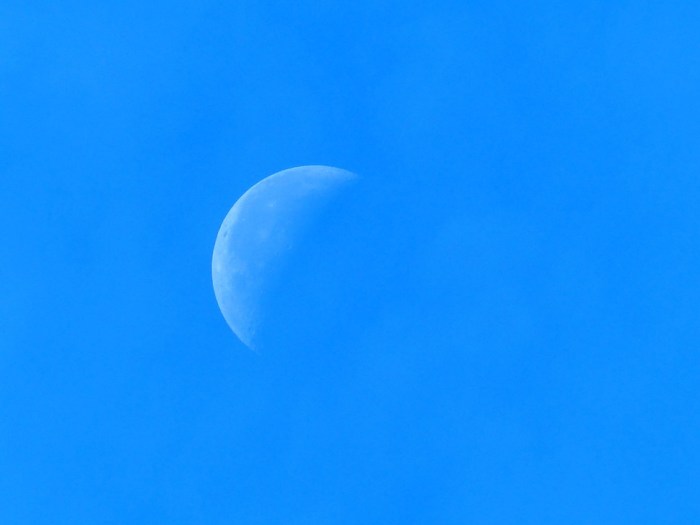
I have been measuring the first month of my transition to a new location in incremental steps of rising and setting moments, at times feeling like I am spinning in the same place. The moon has been a signifier that in nature’s pattern, I can predict the appearance of light in darkness. My aha awareness increased near the end of the month. Sitting on the same deck peering into the midday sky, I unexpectedly saw the moon at high noon; light upon light. Who looks for a sign of constancy when the day is bright? Who celebrates such an appearance?

My vantage point changes, but the predictable sky companion does not. I have moved on my own orbital path this month, a bit further away from my grandchildren, but they are always in my universe. In fact the moon gives us a shared vantage point. In just a few days as we are standing on different grounds, looking from different angles, we can both sing “I see the moon and the moon sees me. God bless the moon and God bless me.” I like that thought.

If you are interested in moon gazing, this link provides a 12 month chart of the phases.

http://www.calendar-12.com/moon_phases/2016

half-moon-187698_960_720


Mountain Dweller

I can condense the description of my natural world context into two sentences. Born near the waters of the Atlantic Ocean, my soul stirs with the sun, sand, and salted waves. Wandering in the Blue Ridge Mountains, hiking a path one footstep at a time, my spirit soars. For the past 32 years I have flourished in a location where I could easily access both.  However, my busy years of doing are slowly being transformed into a desire to find peace and satisfaction in just being in the here and now.  I have experienced a repeated nudge to attend to the inner life of the spirit, my mountain way of being.

In World Religions: A Guide to Our Wisdom Traditions Huston Smith writes that the differences in human nature call for a variety of paths towards life’s fulfillment. Just as Christianity examines the changing landscapes of spiritual life that intersect with human growth, Hinduism describes different stages of life that call for their own agendas. In the second half of life – defined as the time that grandchildren arrive – individuals may claim the license of age, withdrawing from obligations shouldered during earlier years. Huston summarizes the Hindu principle of this later stage in life. “Relief is in order lest life ends before we understand it.”

I find that in western culture it takes a certain courage and determination to claim these years for spiritual adventuring which Hindus refer as the time of the forest dweller. In reflection I am quite certain I am both interpreting and simplifying the Hindu world. However, Smith notes that forest dwellers are working a philosophy into a way of life, pulling up stakes unless things continue as they always have. He writes that in time one becomes inner directed to the point where it doesn’t matter where you are – market place, farming village, forest, or mountain, one reenters the world a different person, a truer self.

In these past months of labor and silence I have been furiously examining, evaluating, packing up the elements of my past life, honoring the memories and simplifying the possessions, yielding to a draw to quiet solitude that is just a breath away from vibrant community. I have learned much about our ultimate dying in the process, for letting go requires immense effort, the support of community, the embrace of multiple losses and the courage to trust in possibility. For months I have been making arrangements. Now I am embracing new life as a mountain dweller. How about that!

10641

Dawn Chorus

I awoke at dawn this morning to the amazing spring chorus of bird song. How can such a cacophony of notes create such beauty and harmony? Surely this is what the psalmist calls a morning of heavenly praise. “Give praise to the beloved O heavenly hosts, sing of Love’s glory and strength (psalm 29).”

The scientists refer to this occurrence as the dawn chorus. When the light is too dim for the birds to yet begin to forage, the feathered creatures find time for full-throated social interaction. “Listen,” sings the male, “I am strong and vital.” I am certain the 21st century female replies, “So am I. So am I.” For the most part I am cannot identify the birds’ signature songs, yet even the long drawn out lament of the mourning dove sounds hopeful.

Grateful for a blessing at the start of my day, I listened from my bed perch for most of an hour imagining the tree tops all through my neighborhood filled with song. I pictured a wave of dawning light moving around the earth accompanied by a chorus. Just as the volume began to diminish, a single crow swooped in with his raucous attempt to stake his own claim on the day. Close behind came the rushing sounds of tires as the world stirred into action.

On the first Sunday in May the United Kingdom celebrated International Dawn Chorus Day, and encouraged people to rise in the early hours of the morning, to step outside and to listen to this awesome performance. We missed the date, but if you seek out “dawn chorus” online, you will find many recordings of this phenomena – not quite the same as rising early in the morning, but inspiring none the less.

dawn chorus

Fooling with Words: Celebrate Poetry

The days of the month slip from April to May. I want to do my share to celebrate poetry and applaud poets who gift me with words. While I am a literature lover, it was late in life when I fell in love with poetry. Though I have always enjoyed the familiar Dickinson or Frost, and laughed with my children through Shel Silverstein’s play land of words, for too, too long I approach the work of poets as ingenious expressions that I needed to analyze, dissect, or diagram in order to take away the meaning. And if I didn’t “get it”, well that was my fault, not the poet’s.

Bill Moyers’ Fooling with Words introduced me to another world of poets, and I began to feel the way words slip across my tongue, creating life-giving harmonies; producing words, lines, phrases that resonated within my soul – like “Yikes!” “Yippee!” “Oh yes!” “Oh my!” I discovered words expressing beliefs, values, experiences that direct my path; painting pictures I can step into; making more evident the mysteries of life; celebrating the universe; praising the divine.

Any list I make would be incomplete, but over the years I have been smitten with Coleman Barks, Jane Hirshfield, Marge Piercy, Maya Angelou, Wendell Berry, Pablo Neruda, Langston Hughes, Bill Collins, Mary Oliver, Denise Levertov . . . I have poetry of the lesser known but equally gifted writers, some of whom I have met in my writing groups.

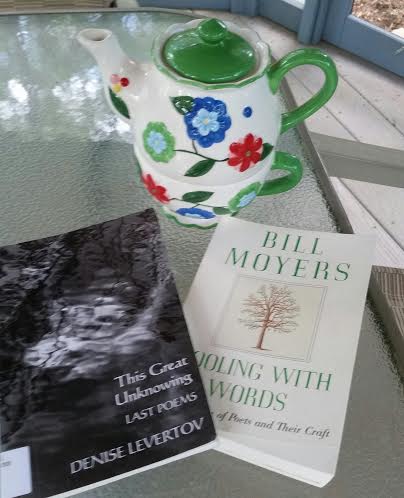
Earlier this month, I scanned the library poetry display for a new read and picked up Denise Levertov’s The Great Unknowing. The title and cover told me there was something to be discovered in its pages. These forty poems were finished but unpublished at the time of her death. At the age of 74, Denise Levertov left behind a half century of twenty volumes of poetry.

I gasp with delight as I read  “Aware”.

“When I opened the door

I found the vine leaves

speaking among themselves in abundant

whispers

My presence made

them hush their green breath,

embarrassed; . . .”

In “a Clearing” she takes us to the end of an enticing country road arriving at a

“paradise of cedars . . .

an expanse of sky where trees and sky

together protect the clearing.

One is sheltered here

from the assaulted world . . .

It is a paradise and paradise

is a kind of poem, it has

a poem’s characteristics:

inspiration, starting with the given;

unexpected harmonies; revelation.

It’s rare among

the worlds one finds

at the end of enticing driveways.”

Keeping company with the poets is like sitting with kinfolk or the best of friends, sharing ordinary wisdom or fooling with words. Delightful afternoon with a cup of tea.
fooling with words

World Within Worlds

Words are another wow factor in my life. Since childhood I have opened the pages of my dictionary with the wonder of discovery – the origin, variants of meaning, pronunciation, uses in a sentence, synonyms, and antonyms. I was clearing off a bookshelf last week, and discovered the Merriam Webster I had used since college days – its worn blue cover, the binding pulling away from the spine at the corners. Inside the cover I had at one time begun to make a list of the words I had looked up – harridan (scolding old woman), insouciant (lighthearted unconcern)….I don’t often use its pages these days because my fingers more immediately type the word in Google search and open up whole new worlds of information.

This past week I stumbled into an expanding universe of new words, and developed an enormous admiration for those that have explored the heavens as astronomers, despite odds I could not have fathomed. In the novel, The Stargazer’s Sister, Carrie Brown recreates from the nineteenth century the story of Carolina Herschel, sister of composer and astronomer William Hershel. At a very early age “Lina” falls under the influence of her brilliant brother, twelve years her senior, as he opens her mind and imagination to a world beyond what we see.

Animalcules – that’s the word that first grabbed my imagination. William delights in giving Lina vivid images of the discovery of animalcules. I immediately liked the way this unfamiliar word slipped across my tongue, and formed images of microscopic animals. I needed to know more. Animalcules – Dutchman Anton va Leeuwenhoeck’s name for the little swimmers he discovered in his microscope. After her introduction to the microscopic world, Lina begins to draw animalcules with tails and horns.. When William points out that these animalcules are “worlds within worlds”, Lina began to see in each raindrop that ran down the glass window a whole city with “its minarets and towers, its bustling populace” (17).

Herschel, captivated by the stars, had already begun his own quest to build a telescope of mighty proportions, in order to see the hidden world in the night skies. I am not sure why I was caught off guard to discover that the prevailing attitude of the times created barriers in his efforts, for he was tampering with God’s territory. We do seem to fear whatever challenges the world as we know it. I know I don’t want to ever lose the wonder of our universe, and miss seeing the “worlds within worlds.” It’s rather tied to a realization that I am not ever alone or totally on my own. There it is again -that immense web of relationships that forms every aspect of our universe.

Today’s language for what can be seen under the microscope or at the end of telescopes creates a vocabulary well beyond my claim for knowledge. Animacules – now that’s something I can get my head around. Little swimmers invisible to the naked eye, but essential to my world, mysteries to unfold. Cause for gratitude for the unseen life that makes my own existence possible.


Taking Another Look

In A Whole New Life, Reynolds Price describes returning to New York City for the first time confined to a life in wheelchair and gaining a new eye level perspective of those who lived on the streets. Listening to Price recount this story in 1994 at a book reading was a pivotal moment that left a sensitive mark in my own awareness – there are so many ways to see the world. To see through new eyes, to understand a new perspective is not only a privilege but an essential view of a world marked with diversity.

I spent just such an eye-opening day during spring break with my granddaughter. The day began in her back yard where we visited the world of inch-worms dangling from threads, doing pushups on the stone path, or inching their way along every visible surface. “Look here,” she says, “this one is posing for a picture. Did you know that male inchworms have black stripes?” I could hardly stifle my response, “How about that!”

When she took my hand to help me across the street for an excursion in the neighborhood park, I knew I was a very special somebody about to be introduced to marvels I would otherwise miss in my “push through, get it done” approach to life. She pointed out blue-faced forget me nots, the polished yellow gold of buttercups, fields of violets, and first appearances of dandelions, along with numerous tiny white, pink, or purples flecks of wildflowers smaller than her petite fingertip.

We collected specimens for further viewing in plastic baggies – lichen and bark scraped from fallen limbs, new sprouts of wild green onions, variegated flower petals falling from shrubs and trees. But we left the moss in place for it “would take another decade for even the smallest patch to be replaced.”

We ended the excursion in a field of clover, looking for the lucky four-leafed specimens, making clover-chain crowns and necklaces. She picked a small bunch of wildflowers to carry home, but not before spontaneously thanking Mother Nature for providing us with these gifts. What wonder to see through the eyes of a child, to celebrate the richness of a splendidly diverse world, to take a walk in slow-motion with no other agenda than to discover the hidden beauties I could so easily overlook.

20160331_113507-1