The Sky is Falling

I am discovering that the wisdom of aging comes with a slowing down, prompting me to sink into the moment at hand. That’s how I began to befriend the sky, conceiving of its presence as an immense blue canvas on which forces of nature paint an accounting of the day just as it is happening. The artist’s pallet holds the elements of light, wind, water, and temperature and produces not simply a representation of life as it is occurring, but the very reality that gives shape to my day, sometimes my very mood. From dawn to evening, night fall to daylight rising, the sky is my protective shell. I count on it being there – and it is – even if I don’t give this a single moment’s thought.

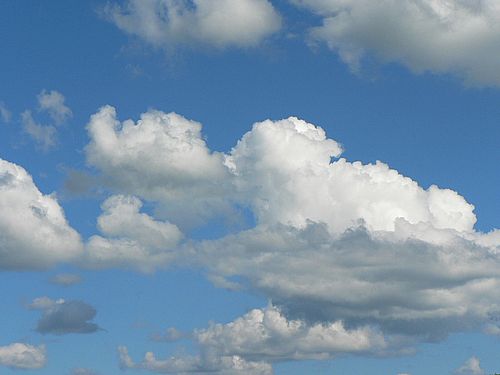
Gazing up at the curved canvas I am reminded of the constancy of change in life, the subtle ways my day, my world is being reshaped. Approaching fall in the mountains, it is difficult not to notice the dense fog that hangs over the early morning. I begin to anticipate, like clockwork, the warmth that will lift the cloud, unveiling the stretched blue fabric of my day. Today the clouds spread like a bed sheet, hanging low and teasing me with its dense gray appearance. Stratus could up to pranks. Will it rain on the roofers and then their work day will stop?

I favor the fairy streaks of high cirrus clouds that produce a light airy step in the day, but it only takes a turn of the head and sky is filled with white puffy cotton candy, the cumulus clouds that appear like mounds of whipped cream. I can quickly fall into my childhood memories, lying on the sand at the beach, naming the clouds by the images they depict.

One of my favorite Charlie Brown cartoons depicts Charlie Brown, Linus, and Lucy lying on the top of a hill. Lucy says “If you use your imagination you can see lots of things in the cloud formations. What do you see, Linus?” “Well those clouds up there look to me like the map of British Honduras…that cloud up there looks a little like the profile of Thomas Eakins, the famous painter and sculptor…over there …the impression of the stoning of Stephen…the apostle Paul standing there to one side.” Lucy replies, “That’s very good…what do you see in the clouds, Charlie Brown?” “Well, I was going to say I saw a ducky and a horsie, but I changed my mind?”

It is all a matter or perspective, isn’t it? Now I see great tears in the blanket that has hung overhead all morning; the brilliant blue canvas reappearing. My life is not separate from nature’s painting of the day; I am encouraged by the change that constantly takes place; I am delighted with the beauty, grateful for the warnings; overwhelmed with the thought that this protective embrace has been present for all generations of peoples. My ancestors stood under this sky. Now that’s a story I could tell.
clouds-in-blue-sky

Blooming Surprise

Surely it was early autumn
when the shooting star
burned its way to earth

planting its dust
in the  humble pine mulch
near our back wall.

Between winter and summer
solstice, particles cooled,
a bulb shaped, roots formed.

I never noticed
the signs of wonder
silently taking place

until a pink six petal
brilliant star appeared
in my garden, mid-July.

Under summer’s burning skies
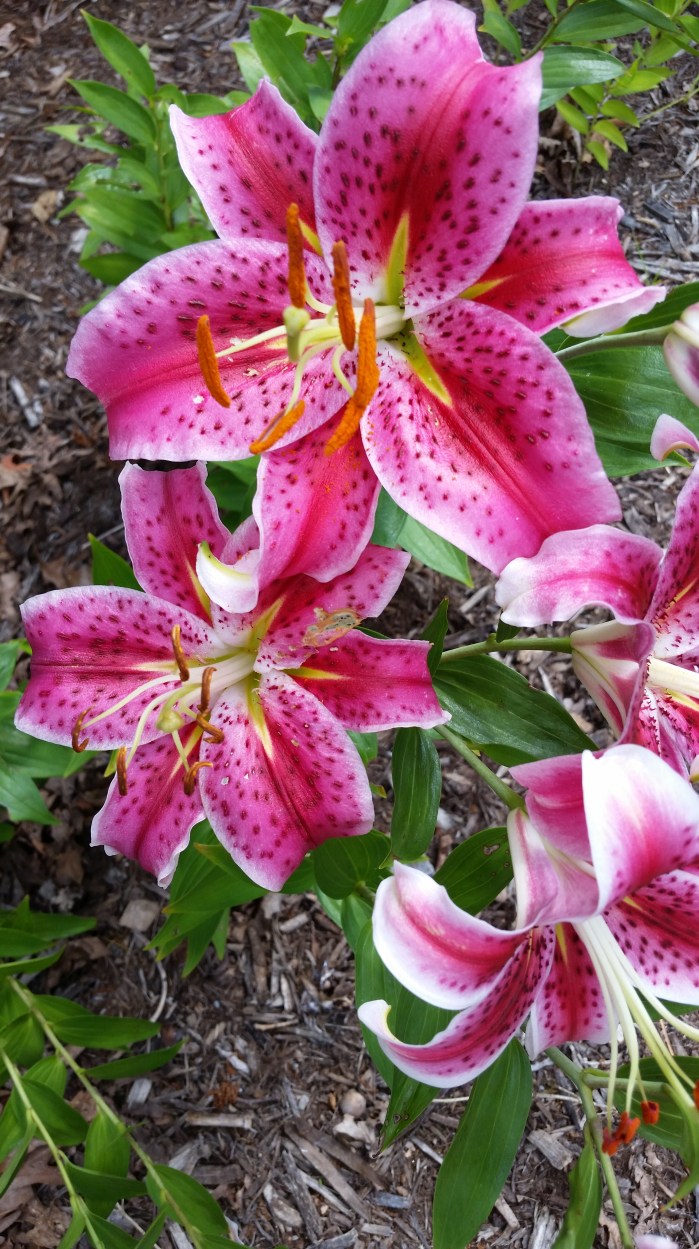
the stargazer lily gives
a glowing performance.

It seems at first that it took but a few seasons to produce such a delight, but when I consider this as a moment in the dynamic, ever continuing history of the universe, I realize that it takes billions of year to bring forth such complex beauty. It is awesome that we have been given a part in this grand story.

20160718_111520

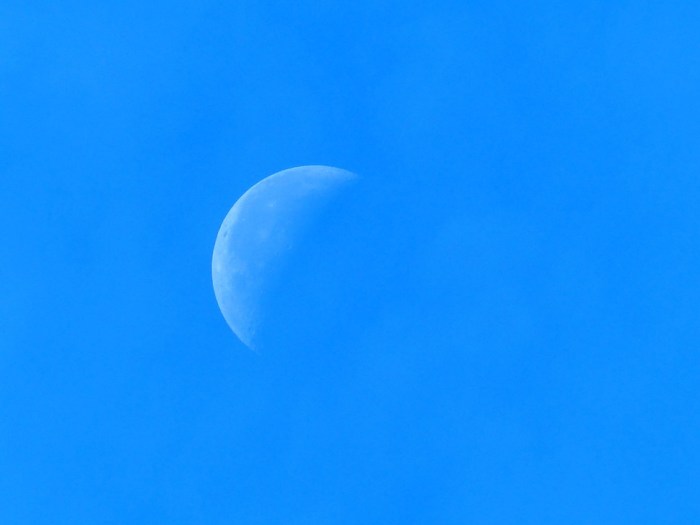
Moon at High Noon

Science is not my forte, but a little bit of knowledge mixed with awe can realign my world. I have come to appreciate the power of observation, which seems to be an essential dimension of a scientific approach. When I create the time and space to pay attention to the world outside my usual frame of reference, I experience mystery and a question eventually emerges.

I’ve been moon watching. Four weeks ago my granddaughter and I sat for the first time on my new mountain-view deck and observed the waxing crescent moon hanging close to Jupiter just after sunset. The June moon was just four days old. We shared the excitement of being amateur backyard astronomers. For the next few nights the moon appeared a bit later, a bit fuller, and bit more to the east. We discovered that thin crescent first day moon we spied in the west was not rising, it was setting.

When my grand-joy returned home, I kept scanning the night sky to feel our connection and realized that without a moon chart, I could not quite predict just where and when it would appear. I began waiting and watching for the arrival of the full moon which would coincide with the June 20 solstice. The night of the solstice I drove to the top of our mountain road to see the bright strawberry moon and offer my gratitude for its reassuring appearances.

I am not sure why “knowing” about the patterns of the orbiting moon helps my appreciating, but I think it is about my becoming a more attentive participant in the mysteries of the universe. Reading the stargazer’s footnotes, I discovered that the convex, protruding moon that later appeared was called the waning gibbous moon, and I already knew that the light would eventually disappear from my night view.

I have been measuring the first month of my transition to a new location in incremental steps of rising and setting moments, at times feeling like I am spinning in the same place. The moon has been a signifier that in nature’s pattern, I can predict the appearance of light in darkness. My aha awareness increased near the end of the month. Sitting on the same deck peering into the midday sky, I unexpectedly saw the moon at high noon; light upon light. Who looks for a sign of constancy when the day is bright? Who celebrates such an appearance?

My vantage point changes, but the predictable sky companion does not. I have moved on my own orbital path this month, a bit further away from my grandchildren, but they are always in my universe. In fact the moon gives us a shared vantage point. In just a few days as we are standing on different grounds, looking from different angles, we can both sing “I see the moon and the moon sees me. God bless the moon and God bless me.” I like that thought.

If you are interested in moon gazing, this link provides a 12 month chart of the phases.

http://www.calendar-12.com/moon_phases/2016

half-moon-187698_960_720


World Within Worlds

Words are another wow factor in my life. Since childhood I have opened the pages of my dictionary with the wonder of discovery – the origin, variants of meaning, pronunciation, uses in a sentence, synonyms, and antonyms. I was clearing off a bookshelf last week, and discovered the Merriam Webster I had used since college days – its worn blue cover, the binding pulling away from the spine at the corners. Inside the cover I had at one time begun to make a list of the words I had looked up – harridan (scolding old woman), insouciant (lighthearted unconcern)….I don’t often use its pages these days because my fingers more immediately type the word in Google search and open up whole new worlds of information.

This past week I stumbled into an expanding universe of new words, and developed an enormous admiration for those that have explored the heavens as astronomers, despite odds I could not have fathomed. In the novel, The Stargazer’s Sister, Carrie Brown recreates from the nineteenth century the story of Carolina Herschel, sister of composer and astronomer William Hershel. At a very early age “Lina” falls under the influence of her brilliant brother, twelve years her senior, as he opens her mind and imagination to a world beyond what we see.

Animalcules – that’s the word that first grabbed my imagination. William delights in giving Lina vivid images of the discovery of animalcules. I immediately liked the way this unfamiliar word slipped across my tongue, and formed images of microscopic animals. I needed to know more. Animalcules – Dutchman Anton va Leeuwenhoeck’s name for the little swimmers he discovered in his microscope. After her introduction to the microscopic world, Lina begins to draw animalcules with tails and horns.. When William points out that these animalcules are “worlds within worlds”, Lina began to see in each raindrop that ran down the glass window a whole city with “its minarets and towers, its bustling populace” (17).

Herschel, captivated by the stars, had already begun his own quest to build a telescope of mighty proportions, in order to see the hidden world in the night skies. I am not sure why I was caught off guard to discover that the prevailing attitude of the times created barriers in his efforts, for he was tampering with God’s territory. We do seem to fear whatever challenges the world as we know it. I know I don’t want to ever lose the wonder of our universe, and miss seeing the “worlds within worlds.” It’s rather tied to a realization that I am not ever alone or totally on my own. There it is again -that immense web of relationships that forms every aspect of our universe.

Today’s language for what can be seen under the microscope or at the end of telescopes creates a vocabulary well beyond my claim for knowledge. Animacules – now that’s something I can get my head around. Little swimmers invisible to the naked eye, but essential to my world, mysteries to unfold. Cause for gratitude for the unseen life that makes my own existence possible.