The Sky is Falling

I am discovering that the wisdom of aging comes with a slowing down, prompting me to sink into the moment at hand. That’s how I began to befriend the sky, conceiving of its presence as an immense blue canvas on which forces of nature paint an accounting of the day just as it is happening. The artist’s pallet holds the elements of light, wind, water, and temperature and produces not simply a representation of life as it is occurring, but the very reality that gives shape to my day, sometimes my very mood. From dawn to evening, night fall to daylight rising, the sky is my protective shell. I count on it being there – and it is – even if I don’t give this a single moment’s thought.

Gazing up at the curved canvas I am reminded of the constancy of change in life, the subtle ways my day, my world is being reshaped. Approaching fall in the mountains, it is difficult not to notice the dense fog that hangs over the early morning. I begin to anticipate, like clockwork, the warmth that will lift the cloud, unveiling the stretched blue fabric of my day. Today the clouds spread like a bed sheet, hanging low and teasing me with its dense gray appearance. Stratus could up to pranks. Will it rain on the roofers and then their work day will stop?

I favor the fairy streaks of high cirrus clouds that produce a light airy step in the day, but it only takes a turn of the head and sky is filled with white puffy cotton candy, the cumulus clouds that appear like mounds of whipped cream. I can quickly fall into my childhood memories, lying on the sand at the beach, naming the clouds by the images they depict.

One of my favorite Charlie Brown cartoons depicts Charlie Brown, Linus, and Lucy lying on the top of a hill. Lucy says “If you use your imagination you can see lots of things in the cloud formations. What do you see, Linus?” “Well those clouds up there look to me like the map of British Honduras…that cloud up there looks a little like the profile of Thomas Eakins, the famous painter and sculptor…over there …the impression of the stoning of Stephen…the apostle Paul standing there to one side.” Lucy replies, “That’s very good…what do you see in the clouds, Charlie Brown?” “Well, I was going to say I saw a ducky and a horsie, but I changed my mind?”

It is all a matter or perspective, isn’t it? Now I see great tears in the blanket that has hung overhead all morning; the brilliant blue canvas reappearing. My life is not separate from nature’s painting of the day; I am encouraged by the change that constantly takes place; I am delighted with the beauty, grateful for the warnings; overwhelmed with the thought that this protective embrace has been present for all generations of peoples. My ancestors stood under this sky. Now that’s a story I could tell.

clouds-in-blue-sky

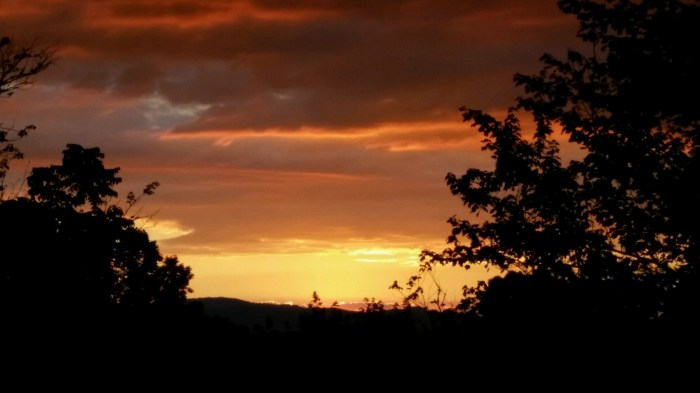
Mountain Dweller

I can condense the description of my natural world context into two sentences. Born near the waters of the Atlantic Ocean, my soul stirs with the sun, sand, and salted waves. Wandering in the Blue Ridge Mountains, hiking a path one footstep at a time, my spirit soars. For the past 32 years I have flourished in a location where I could easily access both.  However, my busy years of doing are slowly being transformed into a desire to find peace and satisfaction in just being in the here and now.  I have experienced a repeated nudge to attend to the inner life of the spirit, my mountain way of being.

In World Religions: A Guide to Our Wisdom Traditions Huston Smith writes that the differences in human nature call for a variety of paths towards life’s fulfillment. Just as Christianity examines the changing landscapes of spiritual life that intersect with human growth, Hinduism describes different stages of life that call for their own agendas. In the second half of life – defined as the time that grandchildren arrive – individuals may claim the license of age, withdrawing from obligations shouldered during earlier years. Huston summarizes the Hindu principle of this later stage in life. “Relief is in order lest life ends before we understand it.”

I find that in western culture it takes a certain courage and determination to claim these years for spiritual adventuring which Hindus refer as the time of the forest dweller. In reflection I am quite certain I am both interpreting and simplifying the Hindu world. However, Smith notes that forest dwellers are working a philosophy into a way of life, pulling up stakes unless things continue as they always have. He writes that in time one becomes inner directed to the point where it doesn’t matter where you are – market place, farming village, forest, or mountain, one reenters the world a different person, a truer self.

In these past months of labor and silence I have been furiously examining, evaluating, packing up the elements of my past life, honoring the memories and simplifying the possessions, yielding to a draw to quiet solitude that is just a breath away from vibrant community. I have learned much about our ultimate dying in the process, for letting go requires immense effort, the support of community, the embrace of multiple losses and the courage to trust in possibility. For months I have been making arrangements. Now I am embracing new life as a mountain dweller. How about that!

10641

Taking Another Look

In A Whole New Life, Reynolds Price describes returning to New York City for the first time confined to a life in wheelchair and gaining a new eye level perspective of those who lived on the streets. Listening to Price recount this story in 1994 at a book reading was a pivotal moment that left a sensitive mark in my own awareness – there are so many ways to see the world. To see through new eyes, to understand a new perspective is not only a privilege but an essential view of a world marked with diversity.

I spent just such an eye-opening day during spring break with my granddaughter. The day began in her back yard where we visited the world of inch-worms dangling from threads, doing pushups on the stone path, or inching their way along every visible surface. “Look here,” she says, “this one is posing for a picture. Did you know that male inchworms have black stripes?” I could hardly stifle my response, “How about that!”

When she took my hand to help me across the street for an excursion in the neighborhood park, I knew I was a very special somebody about to be introduced to marvels I would otherwise miss in my “push through, get it done” approach to life. She pointed out blue-faced forget me nots, the polished yellow gold of buttercups, fields of violets, and first appearances of dandelions, along with numerous tiny white, pink, or purples flecks of wildflowers smaller than her petite fingertip.

We collected specimens for further viewing in plastic baggies – lichen and bark scraped from fallen limbs, new sprouts of wild green onions, variegated flower petals falling from shrubs and trees. But we left the moss in place for it “would take another decade for even the smallest patch to be replaced.”

We ended the excursion in a field of clover, looking for the lucky four-leafed specimens, making clover-chain crowns and necklaces. She picked a small bunch of wildflowers to carry home, but not before spontaneously thanking Mother Nature for providing us with these gifts. What wonder to see through the eyes of a child, to celebrate the richness of a splendidly diverse world, to take a walk in slow-motion with no other agenda than to discover the hidden beauties I could so easily overlook.

20160331_113507-1

Invitation to “Come What May”

From the beginning – I have scribbled in notebooks since I was eight years old, wanting to make sense of the world through words. I thought that perhaps arriving at the just-right alignment of words in my universe should put everything in perfect order. In January, I celebrated my 70th birthday and to date I am still playing with words. Along the way I learned to love the process rather than the outcome and to embrace the questions more than the answers. Awe and discovery keep me alert and what I don’t know or didn’t realize continues to absolutely amaze me.

When my grandchildren uncovered this truth, they became my echoes. Listening to their adventures, their creative spins on life, and astute observations, I am apt to say “How about that!”. They turn to me with big grins, a shake of their heads and repeat “How about that!”. “It must be an old-people’s thing”, they say. Yes, I am elder-ing and love this curve in my life. All my life I have been nourished by writers, and now that I am moving at a more measured pace, I want to join their ranks, taking my turn at spinning the wheels of wisdom.

Welcoming the privileges of being an old lady, I am also much more willing to “let come what may”. Instead of making my to-do lists, I rely on a notepad shaped like the bottom of my morning coffee cup. I randomly scribble those things I should consider doing inside the circle – something like a daily mandala. Then I pay attention to what floats to the surface, and gives me a nudge. I like to think of this method as an organic approach to my day. My posts will be just that – an organic emerging of “come what may”.  I welcome you to join me in the wanderings and wonderings. How About That!