Moon at High Noon

Science is not my forte, but a little bit of knowledge mixed with awe can realign my world. I have come to appreciate the power of observation, which seems to be an essential dimension of a scientific approach. When I create the time and space to pay attention to the world outside my usual frame of reference, I experience mystery and a question eventually emerges.

I’ve been moon watching. Four weeks ago my granddaughter and I sat for the first time on my new mountain-view deck and observed the waxing crescent moon hanging close to Jupiter just after sunset. The June moon was just four days old. We shared the excitement of being amateur backyard astronomers. For the next few nights the moon appeared a bit later, a bit fuller, and bit more to the east. We discovered that thin crescent first day moon we spied in the west was not rising, it was setting.

When my grand-joy returned home, I kept scanning the night sky to feel our connection and realized that without a moon chart, I could not quite predict just where and when it would appear. I began waiting and watching for the arrival of the full moon which would coincide with the June 20 solstice. The night of the solstice I drove to the top of our mountain road to see the bright strawberry moon and offer my gratitude for its reassuring appearances.

I am not sure why “knowing” about the patterns of the orbiting moon helps my appreciating, but I think it is about my becoming a more attentive participant in the mysteries of the universe. Reading the stargazer’s footnotes, I discovered that the convex, protruding moon that later appeared was called the waning gibbous moon, and I already knew that the light would eventually disappear from my night view.

I have been measuring the first month of my transition to a new location in incremental steps of rising and setting moments, at times feeling like I am spinning in the same place. The moon has been a signifier that in nature’s pattern, I can predict the appearance of light in darkness. My aha awareness increased near the end of the month. Sitting on the same deck peering into the midday sky, I unexpectedly saw the moon at high noon; light upon light. Who looks for a sign of constancy when the day is bright? Who celebrates such an appearance?

My vantage point changes, but the predictable sky companion does not. I have moved on my own orbital path this month, a bit further away from my grandchildren, but they are always in my universe. In fact the moon gives us a shared vantage point. In just a few days as we are standing on different grounds, looking from different angles, we can both sing “I see the moon and the moon sees me. God bless the moon and God bless me.” I like that thought.

If you are interested in moon gazing, this link provides a 12 month chart of the phases.

http://www.calendar-12.com/moon_phases/2016
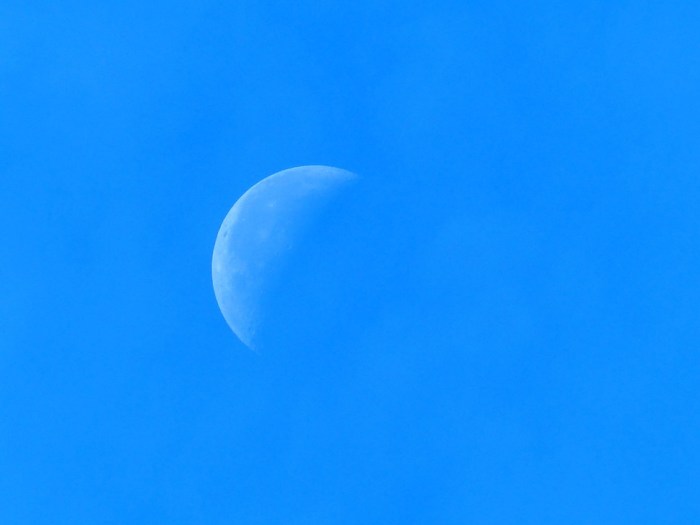
half-moon-187698_960_720


World Within Worlds

Words are another wow factor in my life. Since childhood I have opened the pages of my dictionary with the wonder of discovery – the origin, variants of meaning, pronunciation, uses in a sentence, synonyms, and antonyms. I was clearing off a bookshelf last week, and discovered the Merriam Webster I had used since college days – its worn blue cover, the binding pulling away from the spine at the corners. Inside the cover I had at one time begun to make a list of the words I had looked up – harridan (scolding old woman), insouciant (lighthearted unconcern)….I don’t often use its pages these days because my fingers more immediately type the word in Google search and open up whole new worlds of information.

This past week I stumbled into an expanding universe of new words, and developed an enormous admiration for those that have explored the heavens as astronomers, despite odds I could not have fathomed. In the novel, The Stargazer’s Sister, Carrie Brown recreates from the nineteenth century the story of Carolina Herschel, sister of composer and astronomer William Hershel. At a very early age “Lina” falls under the influence of her brilliant brother, twelve years her senior, as he opens her mind and imagination to a world beyond what we see.

Animalcules – that’s the word that first grabbed my imagination. William delights in giving Lina vivid images of the discovery of animalcules. I immediately liked the way this unfamiliar word slipped across my tongue, and formed images of microscopic animals. I needed to know more. Animalcules – Dutchman Anton va Leeuwenhoeck’s name for the little swimmers he discovered in his microscope. After her introduction to the microscopic world, Lina begins to draw animalcules with tails and horns.. When William points out that these animalcules are “worlds within worlds”, Lina began to see in each raindrop that ran down the glass window a whole city with “its minarets and towers, its bustling populace” (17).

Herschel, captivated by the stars, had already begun his own quest to build a telescope of mighty proportions, in order to see the hidden world in the night skies. I am not sure why I was caught off guard to discover that the prevailing attitude of the times created barriers in his efforts, for he was tampering with God’s territory. We do seem to fear whatever challenges the world as we know it. I know I don’t want to ever lose the wonder of our universe, and miss seeing the “worlds within worlds.” It’s rather tied to a realization that I am not ever alone or totally on my own. There it is again -that immense web of relationships that forms every aspect of our universe.

Today’s language for what can be seen under the microscope or at the end of telescopes creates a vocabulary well beyond my claim for knowledge. Animacules – now that’s something I can get my head around. Little swimmers invisible to the naked eye, but essential to my world, mysteries to unfold. Cause for gratitude for the unseen life that makes my own existence possible.


Brief Lesson on the Invisible

Over the past two years I have been working on a spiritual memoir exploring the beliefs essential to my faith identify as they have been shaped by the circumstances of my life, in particular love, suffering, death, and resurrection. The foundation of my belief occurs in experiencing a relationship with the divine, whom I call God. Though I know God as the single unchanging presence in my life, my relationship and my understanding have definitely evolved. How could I possibly contain the infinite in a single metaphor or encounter?

Several years ago, searching for the God within and around me, I could best “see God” in the goodness of others. Otherwise the invisible divine was “out there”.  But in truth I wanted to feel myself submersed in the God of love. I wanted to experience an unbreakable connection. Watching the sunlight pour through the window over my shoulder, I noticed for the thousandth time the specks of particles dancing in the sunbeam, matter that would become invisible when the sunlight moved

In that moment I grasped as never before that all that seems like empty space – within and around me – is filled with the presence of the divine. It is so difficult to feel alone when I am surrounded by the teeming waves of God’s infinite love. It is difficult to feel powerless when I am wrapped in the energy of God’s love pulling me forward.

Recently I began to read Carlo Rovelli’s Seven Brief Lessons on Physics described on the flyleaf as “All the Beauty of Modern Physics in Fewer than a Hundred Pages”, a “book about joy of discovery”, and “surprisingly easy to grasp”. How I could I pass up this “best selling” opportunity to expand my horizons into the broader universe – in less than 100 pages.

The first chapter – I read at least three time – describes one of the great insights of Einstein which parallels the transformation in my understanding of God. When imagining the force of gravity that draws all material bodies towards one another, Newton described bodies moving through space, a great, empty container. “What the ‘space was made of, this container of the world he invented,” Newton could not say (5).” Later Einstein in a “stroke of pure genius” realized that Newton’s “space” through which things move, and the “gravitational field” are the same. Space is no longer distinct from matter, it is an “entity that undulates, flexes, curves, twists.” How about that! Space in not emptiness, nor is it a fixed container. Neither is God. And the universe, as I read it, says Amen, so it is. How about that!