Making Music Along the Way

I have three passions: trail hiking in the mountains, observing nature in a silent setting, and music. I am compelled to write about the first two – trying to lean into, savor the wonder and awe. The third experience for me is most often wordless – sounds and rhythms that empty me of all other pondering, resonating in my heart, sometimes speaking words buried in my spirit. All three passions share the results of liberation from whatever burdens, obsessions, or anxieties I carry about every day. I enjoy a wide range of music performers, but am drawn these days to Bluegrass, Traditional, and the soul of a few folksingers. A recent music and storytelling event moved me to words because the sounds and rhythms were set between tales I have never heard.

I live in a world where buskers are a part of the fabric of the city; they also find themselves playing by the “rules”, like assigned slots for street corners and building entrances. In Asheville they formed a Collective to create a conversation with the policy makers to benefit street entertainers as well as the city’s economic and cultural life. To walk through town is to be drawn from one corner to the next by street musicians.

The only word to truly describe Abby the Spoonlady is mesmerizing. Experiences of silent listening, joyous wonder, and a bit of movement. When Abby plays on the corner of Patton and Biltmore Avenues, a crowd quickly forms. These days she is a popular draw at indoor music venues. Last month I secured tickets for a “second showing” at a local stage. I looked forward to her music with her partner on the road, Chris Rodrigues, a great singer, songwriter in his own right. But I especially wanted hear Abby telling her stories. A first for me.  The two gave a performance that I did not want to end. When the show closed and the stage was silent I captured my experience in words so I could hold onto the memories.  Check out her music and stories. https://spoonladymusic.com/spoon-lady-biography/

Abby the Spoonlady wears life as a traveler
in the worn lines of her face; her voice carries
the wisdom of the road and a bounty of love
for those she met along the way – a family
of migrants who stopped to give her a much needed
lift, placing a young child on her lap as she slid
into the back seat; the cold nights spent
on the road with weary others gathered under
concrete bridges; the snowman they built
in the freight yard, topping it with a hard hat
and scattered bits of clothing; this community of
loners watched as workmen stopped to take pictures
of their creation. She helped traveling buddies shove
a comfortable sofa into a rail car to soften yet
another long ride heading somewhere she never
felt she belonged. “It’s not easy” she says, “always
waiting for someone to ask you to leave or just
move along.” Wedged behind a cardboard sign left by
her street mates reading “quarantined,” she hoped
the officers would move away and leave her alone;
she played percussion, drawing the attention of a group
of Chippendales emerging from a bar; they continued their
their routines while an appreciative crowd gathered.
with bells on her feet, and a matched pair of
any old serving spoons she clicked, clacked,
snapped her body, rhythm and movement coming
alive, eyes wide open, brilliant with glee. Abby says
she doesn’t move about too much these days;
her body tells her not to. “I miss the traveling ways –
but I learned all I need to know about being
genuinely myself- with nothing to lose.”

music tree


A Harrowing Spider’s Tale

In my Western NC Mountain community, the signs of fall include Halloween settings – pots of golden yellow and orange chrysanthemums, bales of hay with a variety of pumpkins displayed; carved jack-o-lanterns, scarecrows, as well as signs of ghostly tales with giant black spiders draped on webs strung between shrubs and trees. My relationship with spiders can generally be summarized in the following personal statements: if I have seen one spider, I have seen them all (even if there are 35,000 identified species); there is not one good spider in the arachnid realm (even though left alone a single spider can remove all annoying insects in a house); it is reasonable to swat all spiders on sight (though this can be a sticky endeavor). Of course it is unreasonable to judge every spider by the fright of a black widow or brown recluse. I have no love for either and almost an irrational fear. Just one news blurb in the year 1973 about the disastrous results of one brown recluse hiding in the bottom of someone’s boot and I never take for granted my boots are uninhabited.

Therefore it is all the more surprising that I decided to allow an American house spider clinging to my kitchen window to take up residence in late spring. She remained beyond reach but close enough for careful observation. I wanted to see how she went about her days. Her web was hardly a web at all, rather a disarray of apparently useful silken threads – handy for hanging out and catching a casual insect visitor by surprise. When I opened the shade in the morning, I would discover such unsuspecting insects, often drawn to the kitchen light at night, rather precisely mummified at the spider’s pleasure. Other than watching for prey, this resident spider rarely cleaned house, though her poor eyesight with a distance vision of no more than three or four inches, may be a reasonable excuse. What you don’t see can’t bother you. I on the other hand could see all – except where the daddy spider came into the picture, I suppose only under cover of midnight. The facts are that spiders are completely solitary creature, living and feeding on their own. When ready for mating the male has to search out the rare sexually mature ready female and reach her before his competitors – competition is fierce. On five occasions from early summer to early fall my female created plump birthing sacs. Watching the translucent ballpoint pen sized spiderlings come to life was one of the more interesting observations. On each occasion activity around the sac took place over several days – and then one morning all would disappear. I did wonder where 100-400 arachnids – depending on survival rate – found their own residences.

Mid-way in the summer a second female spider took up residence at the opposite side of the screen and began a parallel life style – messy housekeeper focused on keeping the larder amply supplied with plenty enough insects to go around, periodically leaving a sac full of eggs. Now a possible 200-800 spiderlings found their way into the light of day on my kitchen screen. Though researchers say that the American house spider lives for about a year after reaching maturity, my astute granddaughter says there are about five eggs sacs in a season. Perhaps that is why five egg sacs later, just as October approached I was deep cleaning my own lair and noticed no sac activity, just two female spiders curled into a somewhat fetal position. Now my screen with its messy webs was ready for cleaning. One swipe and the oldest of the female spiders awakened from her stupor and dashed to the ledge. I thought she was deceased of natural causes and was as startled as she was. As it t turned out, I was caught in the act of evicting her. The second spider, however, showed no signs of life. With a quick calculation I surmised that five egg sacs plus four more from female # two could lead to an insurrection. However my spider tale does not end in speculation.

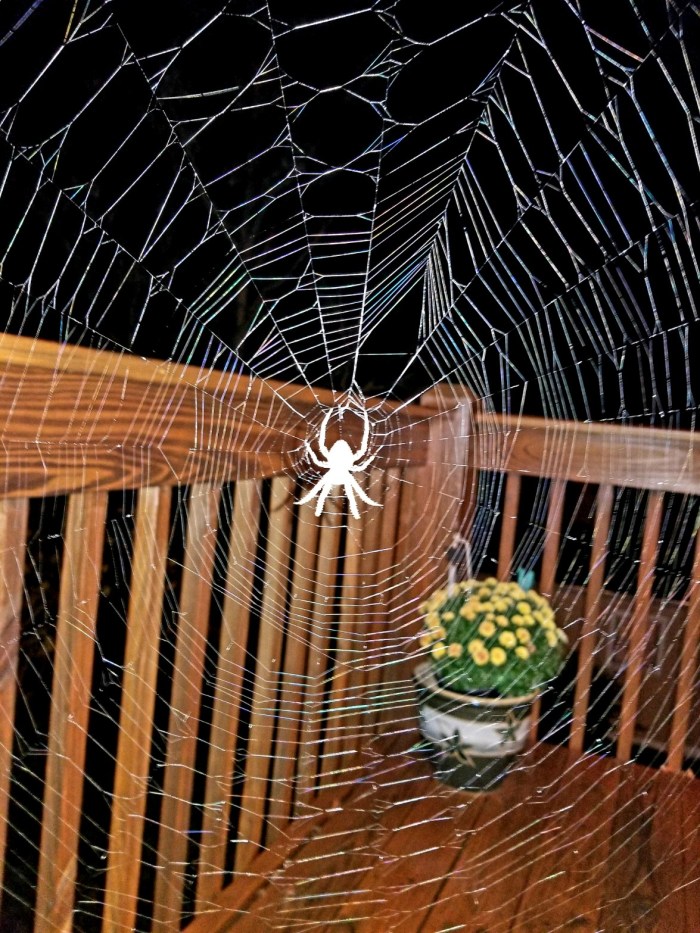
In preparation for fall, I took down webs and put out pumpkins, scare crows and mums. Early this week a new species of arachnid moved in without invitation and no sense of propriety– the back deck orb spider, the kind my daddy called writing spiders. We sighted the sudden appearance of an enormous web from roof line to railing just after sunset, a large visitor with long brown and green striped legs and a cross on its back, sitting bright and center ready for a night watch. Fascinated with its size, appearance, and web, we decided to leave the stunning spider in place for a good night’s catch. The following morning the creature seemed harmless enough to leave for 24 hours of observation and fact finding. How else can I overcome stereotyping a natural world rich with diversity or generalizing a threat from one spider to every spider? Early the next morning when I opened the back deck door to let our dog Kate out for a run, her fluffy coat and tail were suddenly dragging silken threads and I was eye to eye with the big mama spider scrambling for safety. I needed to plan a removal tactic, quick. With a stick in hand I pulled the web down from the gutter and the spider disappeared in a flash. Twenty-four hours later I pushed the door open and the spider appeared in my face within a breath’s reach, strung between door and siding, way too close for comfort. Using my heightened survivalist instinct, I swatted with a newspaper, and the spider and web instantly disappeared- until I felt its legs stretching out on my neck, right near the jugular. I have never practiced karate, but my actions were swift, hand chop from my neck to ground and one good stomp. Sorry, but it is true, I felt my life threaten, having read that the bite of an orb spider when it senses danger can be mean. Well so can mine.  Halloween at my house will go sans any sign of webs or spiders. I leave you with my one and only spider study and will henceforth leave all further spider observations to the eyes of the arachnologists.

https://en.wikipedia.org/wiki/Parasteatoda_tepidariorum

How Spiders Work   https://animals.howstuffworks.com/arachnids/spider8.htm

24167-3


Stories in the Clouds

July slips off the page and August is spinning. Recent heavy rains pressed stalwart purple cone flowers and yellow-eyed daisies to the ground. Stems no longer have the oomph to pick themselves up. Flower heads are quickly turning to seed, ready for a bird’s feast. Yellow and gold mums begin to appear in sun lit garden spots. Walnuts in heavy green husks fall from trees and the squirrels are running in circles. A waning summer saturates my senses.

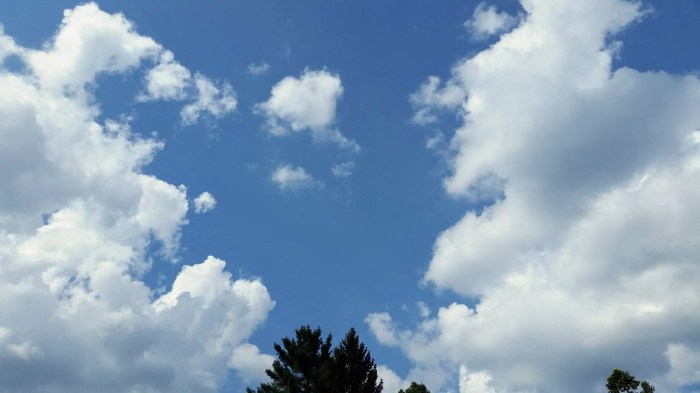
On deliciously slow afternoons I ease onto my front porch rocker, a cup of mint, jasmine, or lady earl grey with lavender tea in hand, ready to watch the clouds write stories in the sky. On the blue story board, narratives unfold in subtle puffs, the main character always a giant of a figure – the Michelin man, a prehistoric flying fish, a fiery dragon with three hind legs, or a massive amoeba swallowing every creature in its path. The hero in the story can transform its powers with a passing breeze. The Michelin man sprouts wings; with a single wave the fish becomes a fleet of sea horses. Remember Poppin Fresh, the Pillsbury dough boy? He rides in on a magic carpet, warning of an impending storm. A clueless puppy flying on all fours plays nearby. My cloud stories have a Hallmark ending, every one playing nice with everyone else by the time it is over. Wait long enough or hardly any time at all, the scenery changes and another story begins. Nature promises an endless narrative.

cloud stories