To Every Season

To everything (turn, turn, turn)
There is a season (turn, turn, turn)
And a time to every purpose, under heaven
(Ecclesiastes 3:1, Pete Seeger 1950’s)

And all because the earth tilts a bit.

The truth as I know it is that while the turn of seasons is inevitable, nature has a contractual clause written in not-so fine print that says “subject to change”. Anticipated patterns can end in the unexpected. Visitors plan their trips to our ancient Pisgah Mountains and the Blue Ridge Parkway months ahead of fall’s scheduled arrival, hoping to catch the peak of a season landscaped in magnificent color. The season is sure to arrive, but nature’s rendering of color and the fullness of the leaf-bearing trees is dependent on rain, temperature, and winds.

This year the predictions of fall’s dramatic presentation have been cautious because of nature’s variables. When the fall calendar indicated the peak season should be arriving, the trees held back their spectacular showing. The ash and chestnut leaves began creating ground cover before the first cooling temperatures, while the red-toothed maples, and dogwoods, the divas of this fall’s fashion show, slowly began to provide the first peeks. Many of the yellows and gold held out for All Saints Day. I delight in whatever dabs of colors appear on nature’s canvas, while simultaneously pondering the reality that this grand presentation precedes nature being stripped to bare bones, creatures burrowing deeper, and birds migrating.

Today winds are pushing heavy gray clouds onto our mountains. Soon enough the clouds bring rain, the rain brings chill. Some bold leaves are holding tight, while plenty of limb-mates are letting go. I catch a view of a mighty oak in its orange blazer proclaiming “it’s not my turn”. When the sun’s performance is hidden behind this curtain, my thoughts take a turn towards the slow and reflective and I feel my world titling towards the moody. Befriending the day means looking for the unseen, unexpected revelation. Between yesterday and today the trees have been shaken and my horizon opens. I can now view the mountain ridges on three sides and give praise for the vision that will sustain me when this season departs. How About That!

fall mountains


What’s Your Winter Story?

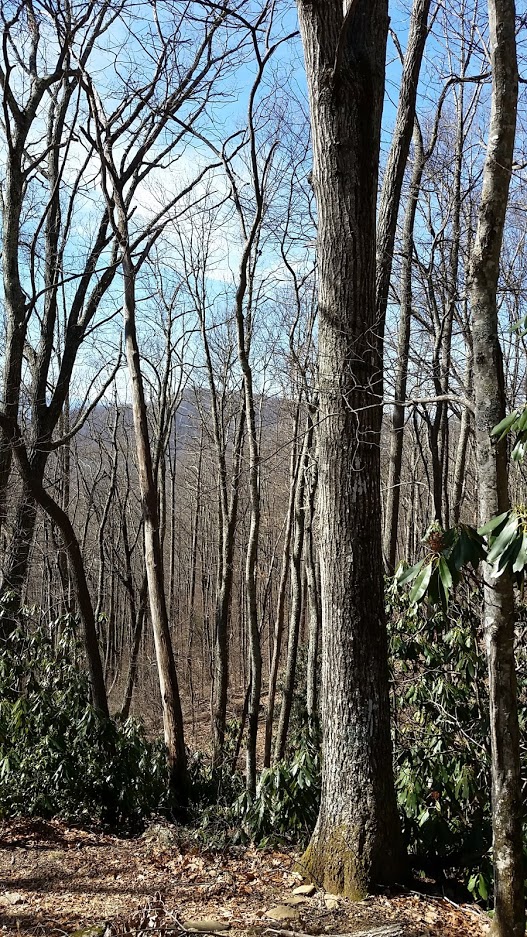
A break in winter’s indisposition,
my boots back on the trail, slow
steady climb to Rattlesnake Lodge.
Satisfaction ripples through my body,
easing the stress of everyday worry.

I pause and lean into the warmth
of ancient boulders surrounded
by a forest of silent  sentinels –

unbending hardwoods, scattered
stands of pines, snarled branches
of mountain laurel, rhododendron green,
snapped limbs,  ample reminders
of the power of wind, plight of rock falls,
telling marks of splintered bark
what’s your winter story?

Dormant stillness belies determination;
even the resting roots are reaching for
nourishment before spring buds open.

winter trees

Curtain Rising

Sitting in the black porch rocker, taking an afternoon break from thinking, planning, doing, I watch yellow birch leaves continue their spiraling dance. A light wind from the East stirs the trees, portending rain and cooler days. Anticipation bubbles within me, like the moments just before the curtain opens on a grand performance, only this is more like a strip tease. Acorns are hitting the ground with popping applause.  After a number of encores, the trees will be bare, revealing a new landscape. I am a newcomer to this stage, first time in this front row seat. The final curtain call will reveal a new horizon.

This well staged drama is a reminder that all life tells the story of change. Carrie Newcomer sings:

Leaves don’t drop they just let go,
And make a place for seeds to grow
Every season brings a change,
A seed is what a tree contains,
To die and live is life’s refrain

Weeks ago when the colors of summer began to fade I was holding onto the scene with a tight grip. “Not yet. Not yet. I am not ready.” All the while I knew change was inevitable. Now I rise to a blessed coolness that takes the edge off the lingering heat, well past the fall equinox. The bite of a honey crisp apple, straight from the tree to me, awakens a taste for Fall. Though I am not fully ready to let go of the peach-sweetness of summer, I begin to imagine the biting tastes of red pepper and cumin in a spicy bowl of chili. The baskets of mums are beckoning and I am once again forced to decide – yellow, gold, purple, or burnt-orange?

I have lived 70 years in a temperate zone and never grown tired of the dramatic production of changing seasons. Nature nurtures an attitude that reminds me to embrace transition – something ever new and eternally the same will be woven together. The curtain will open on a vision that catches the moment between now and then. What has remained hidden from sight can be seen for a time. I am looking forward to the exploring another view. It won’t be the quite same the next time around, and neither will I.

leaves-1036560_960_720


Tale of Two Snags

I listen to the rapid chattering of cicadas in August, riding waves across the still morning sky. My thoughts rattle about for attention. There is much in this world to worry the mind, but I choose to begin with what is right in front of me. For several months I have eyed two dead trees that stand at the far edge of my neighbor’s yard. It is impossible to miss these dry bones and their tangle twigs. They obstruct my view of the horizon, which would otherwise be framed in towering green spires. Reaching out from a vine covered trunk, the branches bear no semblance of symmetry. Believing that I can learn from the patterns and habits of all created things, I begin to wonder what stories these trees hold in their stripped limbs.

Snags. Standing dead trees are referred to as snags. Though I don’t know the true origin of the word, I imagine that the tree limbs in flooded waters can snag boats and create unwanted problems. I have run into a snag or two in my own life. The birds that sometimes hang out in the trees must feel like they have snagged a good place to land. I myself have hoped to snag some good fortune here or there.

This morning I began to ferret out the story these snags might tell. While I may fret about the distorted view of an otherwise sharp horizon, the trees belonged here well before I arrived. Brian Swimme reminds me that over billions of years Earth’s life developed without eyesight. “We contemporary humans identify so strongly with our visual elements of consciousness that we have some difficulty conceiving of a time when life proceeded without any eyes at all…(in Thomas Berry’s The Dream of the Earth).” We have the privilege to see and reflect on the wonders of this world and care about what happens to our natural world. If I consciously turned my eyes towards their twisted limbs what would I learn about the dwelling place I now call home?

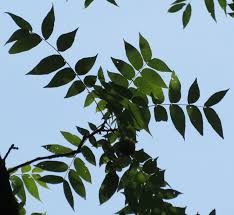
I studied the tree line until it became evident that the bare branches reveal the shape of walnut trees. I first observed just how many walnut trees stood within my sight. I had not really noticed that before. The eastern black walnut is familiar among the hardwoods that cover 90% of the mountains in Western North Carolina. These particular trees were not planted or cultivated. On the downward spiral of Hamburg Mountain, they are pioneer species, a common weed tree, though Native Americans cherished the trees for the wood, the sweet edible nut, and for body oil.

I read about the “thousand canker disease”, carried by the walnut twig beetles which have recently made their way from the west into the Great Smoky Mountains. Without the arborist’s sight, I cannot tell the exact cause of these trees’ death, but I can see in the same line of vision a struggling walnut tree, thin limbs stripped bare at the top, leaves wilting, turning yellow in mid-summer- all signs of the spreading disease.

There is not a moral to this reflection on my challenge to get beyond the annoying sight of dead tree limbs. However, knowing their name, their contribution to this land, and the potential story of their demise gives a personal dimension to these snags anchored by native roots. Studying their habitat I become more familiar with the place I now call home. I stir up a kinship with the natural world that shapes my dwelling place. I know some of their story and see with different eyes their presence in the constantly changing landscape. How about that!

walnut